

How long is 10 feet? This measurement is useful when planning a home renovation, arranging furniture, measuring outdoor spaces, or estimating the size of recreational equipment. However, picturing a distance of 10 feet can be difficult without a familiar object for comparison.
Ten feet equals 120 inches, 304.8 centimeters, or 3.048 meters. It is slightly longer than 3 meters and can be visualized using objects such as a stand-up paddleboard, a staircase, or a section of a swimming pool lane.
How Long Is 10 Feet?
8 Everyday Objects That Show Its Size
Discover how long 10 feet is with 8 familiar everyday objects. Learn its exact length and visualize this measurement with simple comparisons.
How Long Is 10 Feet in Different Measurements?
Before comparing 10 feet with everyday objects, it helps to understand how this measurement translates into other units.
| Unit of Measurement | Equivalent to 10 Feet |
| Feet | 10 feet |
| Inches | 120 inches |
| Centimeters | 304.8 cm |
| Meters | 3.048 meters |
| Yards | 3.33 yards |
The most useful conversion to remember is that 10 feet equals 120 inches. If you are more familiar with the metric system, imagine a straight line that measures just over 3 meters.
This measurement can help when checking the length of furniture, planning a garden layout, estimating room dimensions, or comparing the sizes of recreational equipment.
Remember that a length of 10 feet describes a single dimension. It is different from 10 square feet, which describes an area.
Related Posts: How Long Is 9 Feet? Discover 8 Everyday Size Comparisons
8 Everyday Objects That Help You Visualize 10 Feet
The following eight objects provide practical ways to picture a 10-foot distance. Some may be close to this measurement, while others illustrate how 10 feet compares with familiar objects of different sizes.
1. A Tandem Bicycle
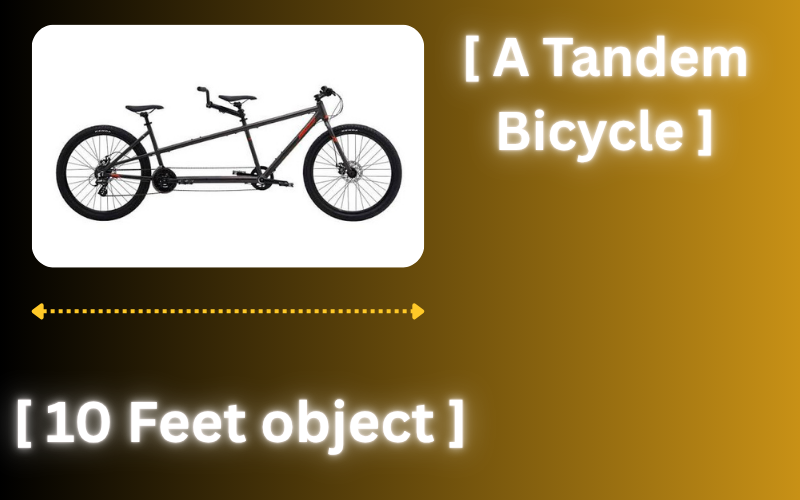
A tandem bicycle is designed to carry two riders on one bicycle frame. It is longer than a conventional bicycle because it needs room for two seats, two sets of pedals, and the associated frame components.
Many tandem bicycles measure approximately 8 to 9 feet long, although some models may be shorter or longer. Their dimensions depend on the frame design, wheel size, and intended riding style.
This makes a tandem bicycle a useful reference for visualizing 10 feet, even though many models do not reach that exact length.
Imagine a tandem bicycle measuring 8.5 feet from its front wheel to its rear wheel. A 10-foot distance would extend another 1.5 feet beyond its length. That extra distance is equivalent to 18 inches.
If you see a tandem bicycle parked outside, imagine extending a straight line from its front wheel to a point 10 feet away. The line would usually extend beyond the rear wheel of many standard tandem models.
This comparison can be useful when estimating storage space in a garage, arranging bicycles in a shed, or planning a place to park recreational equipment.
However, the bicycle’s length is different from its height and handlebar width. For a precise comparison, check the manufacturer’s specifications or measure the bicycle from its frontmost to rearmost point.
Practical comparison: A typical tandem bicycle may approach 10 feet in length, but many models are shorter. Use its actual dimensions to determine how closely it matches the measurement.
2. A Stand-Up Paddleboard
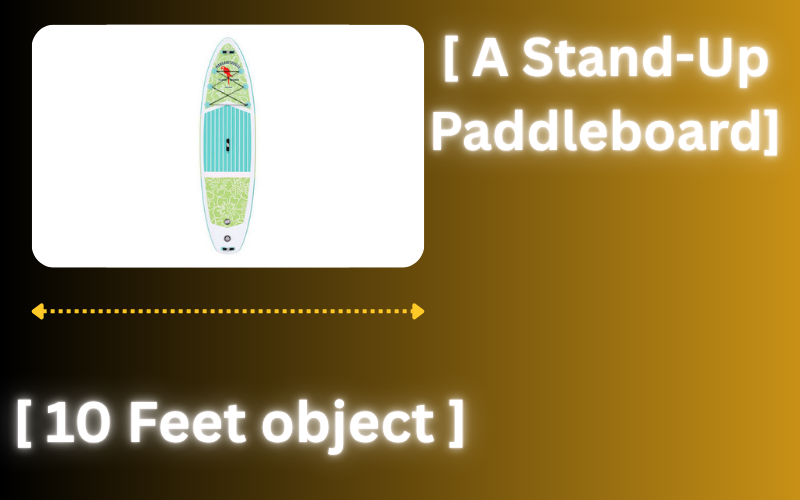
A stand-up paddleboard, commonly called a SUP, is one of the most useful objects for visualizing a length of 10 feet.
These boards are designed for activities such as recreational paddling, exploring calm waterways, and sometimes surfing. They come in different shapes and sizes depending on their intended use.
Many all-around recreational paddleboards measure approximately 10 to 11 feet long. Touring boards may be longer, while some compact boards are shorter.
A paddleboard advertised as 10 feet long provides a direct example of the measurement. Its length equals 120 inches from the nose to the tail.
Imagine laying a 10-foot paddleboard flat on the ground. The distance from its front tip to its back end would show exactly how far 10 feet extends in a straight line.
This comparison is especially useful because paddleboards have a relatively narrow shape, making their overall length easy to visualize. You can imagine the board placed beside a wall or along a clear section of a garage floor.
Keep in mind that the board’s length does not describe its width. A board measuring 10 feet long may be only a few feet wide.
Inflatable and rigid paddleboards can have similar overall lengths, but their shapes and dimensions vary by manufacturer.
Practical comparison: A stand-up paddleboard labeled as 10 feet long provides a straightforward example of a 120-inch distance.
3. A Curtain Track
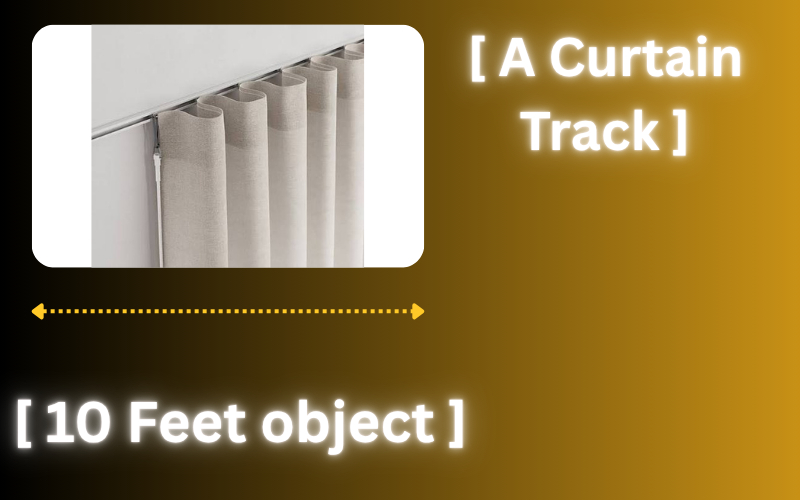
A curtain track is a practical household object that can help you understand a 10-foot measurement.
Curtain tracks are installed above windows, sliding doors, and other openings to support curtains. They are available in different lengths, and some can be cut to size or joined together to cover wider areas.
A 10-foot curtain track measures 120 inches from one end to the other. This makes it a useful example of an object that can be purchased or installed at a specified length.
Imagine looking at a wide window or patio door with a curtain track running across the top. If the track measures 10 feet, the horizontal distance from its left end to its right end is exactly 120 inches.
This can help when planning curtains for a large window, measuring a room, or estimating the space needed for a window treatment.
Curtain tracks vary considerably in length. Smaller residential windows may need much shorter tracks, while wide windows or multi-panel doors may require tracks approaching or exceeding 10 feet.
Some tracks are supplied in sections, so the total installed length may be different from the length of an individual piece.
When buying a track, measure the full area you want to cover and account for any required overlap, end brackets, or installation clearances.
Practical comparison: A curtain track measuring 10 feet provides an exact horizontal reference for visualizing 120 inches.
4. A Staircase

A staircase can help you visualize 10 feet, but the comparison depends on whether you are measuring its height, width, or length along the steps.
Staircases are designed to connect different floor levels. Their dimensions vary according to the building layout, floor-to-floor height, number of steps, and staircase design.
A staircase may have a vertical rise of around 10 feet in some buildings, particularly where the floor-to-floor height is substantial. Other staircases have a much smaller rise.
The distance measured along the sloping staircase is also different from its vertical height. A staircase that rises 10 feet vertically will generally have a longer distance along its inclined path.
To visualize 10 feet, imagine a vertical line extending from the lower floor to a point 10 feet above it. This can help you picture a tall staircase or the height difference between two levels.
You can also use the handrail or the sloping path of the stairs as a reference, provided you distinguish between the actual length along the stairs and the vertical distance.
This comparison is useful when estimating ceiling clearance, planning a renovation, or understanding the dimensions of a stairwell.
However, staircase dimensions should never be guessed when designing or modifying stairs. Building codes specify requirements for tread depth, riser height, handrails, and other safety-related features.
Practical comparison: A staircase with a vertical rise of 10 feet illustrates a height of 120 inches, while its sloping length will generally be greater.
5. A Wooden Pergola

A wooden pergola is an outdoor structure commonly built over patios, garden seating areas, and walkways. It typically consists of vertical posts supporting horizontal beams and overhead rafters.
Pergolas are available in many sizes. Small garden models may be only a few feet wide, while larger structures can span 10 feet or more.
A pergola measuring 10 feet across provides a useful example of this distance. If you stand beside one of its horizontal sides, the distance between the two outer posts may be close to 120 inches, depending on how the structure is measured.
Imagine a pergola installed over a backyard seating area. A 10-foot span could provide room for outdoor chairs, a small table, or a walkway, depending on the design.
The overall dimensions of a pergola can refer to the outside edges of its posts, the distance between the posts, or the dimensions of its roof structure. These measurements are not always identical.
For example, a pergola advertised as 10 feet wide may have an interior opening that is smaller than 10 feet because the posts occupy some of the space.
Wooden pergolas can also expand or contract slightly with changes in moisture and temperature. Accurate measurements are important when constructing a custom structure.
Practical comparison: A pergola with a 10-foot span can help you visualize 120 inches across an outdoor area, although its exact usable opening depends on the post placement.
6. A Streetlight Pole
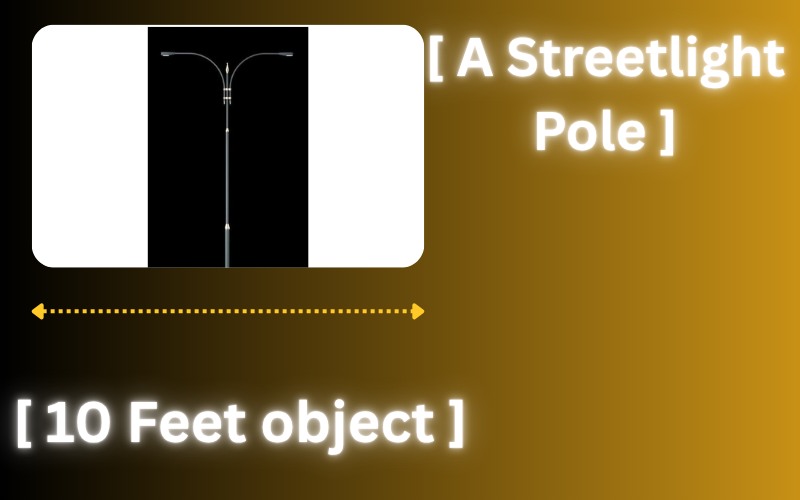
A streetlight pole is a useful reference for understanding vertical measurements, although most permanent streetlight poles are significantly taller than 10 feet.
Streetlights are installed along roads, parking lots, pathways, and public spaces to provide illumination. Their height depends on their purpose and location.
Residential pathway lights may be relatively short, while typical streetlight poles often stand several times taller than 10 feet. Some decorative outdoor lighting poles can be closer to this measurement, but they are not necessarily representative of standard road lighting.
To visualize 10 feet, imagine measuring 120 inches upward from the ground along a pole. This gives you a vertical section that is easy to compare with a person’s height or nearby structures.
For example, a 10-foot vertical section of a taller streetlight pole would represent only part of the pole’s total height.
This is a helpful way to understand vertical distances when estimating the height of outdoor fixtures, garden structures, or other objects.
Remember that the total height of a streetlight pole may include its mounting base and light fixture, depending on the manufacturer’s stated dimensions. The pole itself may also be measured separately from the lamp assembly.
Practical comparison: Imagine a vertical section of a streetlight pole extending 10 feet above the ground. This represents 120 inches, even though many actual streetlight poles are much taller.
7. A Utility Shed
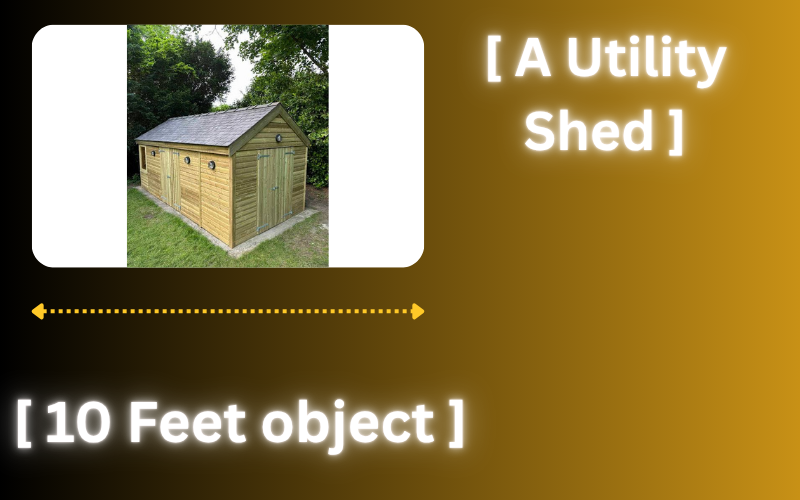
A utility shed can provide a familiar reference for understanding a 10-foot measurement, especially when considering the length or width of a small outdoor building.
Utility sheds are used to store garden tools, lawn equipment, bicycles, seasonal decorations, and other household items. They are available in different materials, including wood, metal, and resin.
Many small storage sheds have dimensions such as 6 by 8 feet, 8 by 10 feet, or 10 by 10 feet. These sizes vary according to the manufacturer and product design.
A shed with a 10-foot side offers a direct reference for visualizing 120 inches. For example, the longer side of an 8-by-10-foot shed measures 10 feet, while its shorter side measures 8 feet.
Imagine standing in front of a rectangular shed that measures 10 feet wide. The distance from one outside edge to the other represents the measurement you are trying to picture.
This comparison can help when planning a garden storage area, checking whether a shed will fit in a yard, or estimating the space needed for outdoor equipment.
However, advertised shed dimensions may describe the exterior footprint, base dimensions, or interior space. The usable interior dimensions are usually smaller than the exterior dimensions because of the walls and framing.
Before purchasing a shed, check the manufacturer’s measurements and allow additional space for doors, access, and installation.
Practical comparison: One side of a shed measuring 10 feet provides a clear example of a 120-inch distance across an outdoor structure.
8. A Swimming Pool Lane
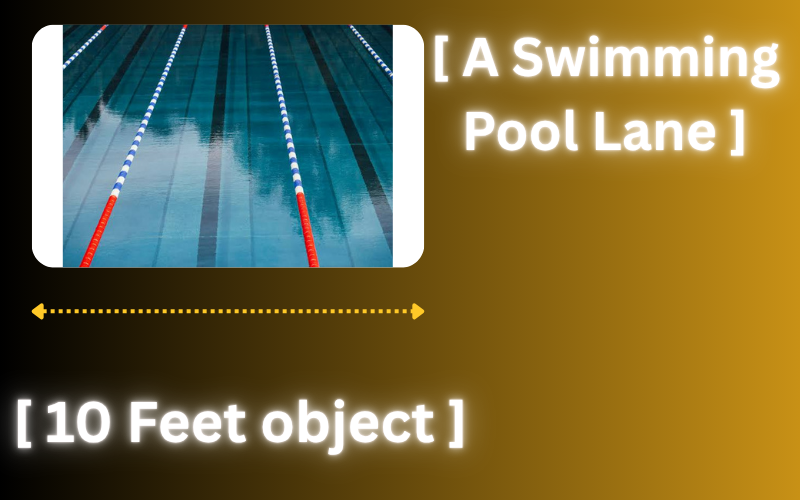
A swimming pool lane provides an interesting comparison because it is much longer than 10 feet in most standard pools.
Pool lanes are marked to organize swimmers and separate swimming paths. Their dimensions depend on the pool’s overall size and the number of lanes.
Many competition pools are 25 meters or 50 meters long. A 25-meter pool measures approximately 82 feet long, while a 50-meter pool measures approximately 164 feet long.
Compared with these lengths, 10 feet is only a small section of a swimming pool lane.
In a 25-meter pool, a 10-foot section represents roughly one-eighth of the pool’s length. In a 50-meter pool, it represents an even smaller portion.
Imagine standing beside a swimming pool and looking from one end toward the other. A distance of 10 feet would cover only a short stretch of the lane, rather than the entire pool.
This comparison is useful when estimating distances in sports facilities or understanding how a smaller measurement relates to a much longer space.
Keep in mind that lane width and lane length are different measurements. A pool lane may be several feet wide, but its length is generally much greater than 10 feet.
Practical comparison: Ten feet represents a short section of a standard swimming pool lane, making it a useful way to understand the scale of larger distances.
How to Visualize 10 Feet Without a Measuring Tape
If you do not have a measuring tape, you can estimate 10 feet using familiar objects and simple techniques.
- Think in inches: Ten feet equals 120 inches. Imagine ten sections of 12 inches placed end to end.
- Use a known object: A 10-foot paddleboard or curtain track with verified dimensions can provide a direct reference.
- Compare with a smaller measurement: Eight feet is 2 feet shorter than 10 feet. Adding 24 inches helps you understand the difference.
- Mark a straight line: If you have a ruler, measure successive one-foot sections along the floor until you reach 10 feet.
- Use vertical references: Imagine measuring 10 feet upward along a pole or beside a staircase to understand the height.
These techniques are useful for everyday estimates, but they are not substitutes for precise measurement when installing structures, cutting materials, or planning construction work.
How 10 Feet Compares With the Eight Objects
The following table summarizes how each object relates to a 10-foot measurement.
| Everyday Object | Relationship to 10 Feet |
| A Tandem Bicycle | Many models are around 8–9 feet long, though dimensions vary |
| A Stand-Up Paddleboard | Some recreational boards measure approximately 10 feet long |
| A Curtain Track | Can be supplied or installed at exactly 10 feet |
| A Staircase | May have a vertical rise of 10 feet; sloping length differs |
| A Wooden Pergola | Some models have a 10-foot span or width |
| A Streetlight Pole | A 10-foot section is useful for comparison; many poles are taller |
| A Utility Shed | Some sheds have a side measuring 10 feet |
| A Swimming Pool Lane | Ten feet represents only a short section of a standard pool lane |
These examples show why it is important to consider the particular dimension being measured. The length of an object, its height, and its overall footprint can all be different.
“I hope you learned a lot from this article. Check out more articles like this.”
- How Long Is 9 Feet? Discover 8 Everyday Size Comparisons
- How Long Is 8 Feet? Discover 8 Everyday Size Comparisons
- How Long Is 7 Feet? Discover 8 Everyday Size Comparisons
- How Long Is 6 Feet? Discover 8 Everyday Size Comparisons
- How Long Is 5 Feet? Discover 8 Everyday Size Comparisons
FAQs
1. How many inches are in 10 feet?
Ten feet equals 120 inches. Since each foot contains 12 inches, ten feet is equivalent to ten groups of 12 inches.
2. How many meters is 10 feet?
Ten feet equals 3.048 meters, or approximately 3.05 meters. This makes it slightly longer than 3 meters.
3. Is 10 feet a common length for a paddleboard?
Yes. Many recreational stand-up paddleboards measure around 10 feet long, although some models are shorter or longer depending on their intended use.
4. What everyday object is exactly 10 feet long?
A curtain track or a paddleboard can be exactly 10 feet long if its specified dimensions are 120 inches. A utility shed or pergola may also have a 10-foot side or span, depending on its design.
5. Is a staircase 10 feet long?
Some staircases have a vertical rise of 10 feet, but their sloping length is generally longer. Staircase dimensions depend on the floor height, number of steps, and design.
6. How can I measure 10 feet without a tape measure?
You can estimate 10 feet by comparing the distance with an object of known dimensions or by imagining ten one-foot sections placed end to end. Use a measuring tool when accuracy is important.
7. Why is knowing how long 10 feet is useful?
Understanding 10 feet helps with furniture placement, outdoor planning, construction projects, equipment storage, and comparing product dimensions. It can also help you estimate whether an object will fit into a particular space.
Related Posts: How Long Is 9 Feet? Discover 8 Everyday Size Comparisons
Conclusion
So, how long is 10 feet? It equals 120 inches, 304.8 centimeters, or 3.048 meters. This is slightly longer than 3 meters and provides a useful reference for many everyday measuring tasks.
Objects such as a 10-foot stand-up paddleboard, curtain track, utility shed, or wooden pergola can help you picture the distance. A tandem bicycle provides a nearby comparison, while a staircase and streetlight pole illustrate vertical measurements. A swimming pool lane demonstrates how 10 feet compares with a much longer distance.
Remember that actual dimensions vary by product and design. Use these examples to develop a visual understanding of 10 feet, and check exact measurements whenever you need precision for a home project, purchase, or installation.

Pingback: How Long Is 11 Feet? Discover 8 Everyday Size Comparisons -