

Understanding how long 13 feet is can be challenging when you do not have a measuring tape nearby. Whether you are planning a home improvement project, arranging furniture, measuring an outdoor space, or comparing the dimensions of a large object, familiar examples can help you picture this length more easily.
Thirteen feet is a little shorter than 4 meters, making it a useful measurement to understand for household, construction, and recreational purposes. However, imagining a distance from numbers alone is not always easy. Comparing it with objects such as a small cargo trailer, a drainage pipe, or a large conference table provides a more practical reference.
How Long Is 13 Feet?
8 Everyday Objects That Show Its Size
Discover how long 13 feet is with 8 familiar everyday objects. Learn its exact length and visualize this measurement with simple comparisons.
How Long Is 13 Feet?
Thirteen feet equals 156 inches, 3.9624 meters, 396.24 centimeters, and 4.3333 yards. It is a substantial length for furniture, building materials, recreational equipment, and other large objects.
One simple way to picture this measurement is to imagine a straight line extending almost 4 meters across a room or outdoor area. The distance is longer than many ordinary furniture pieces and can cover a significant portion of a garage, meeting room, or backyard.
Quick Answer
13 feet = 156 inches = 3.9624 meters = 396.24 centimeters = 4.3333 yards.
Here is a quick conversion table for reference.
| Measurement Unit | Equivalent Length |
| Feet | 13 feet |
| Inches | 156 inches |
| Yards | 4.3333 yards |
| Meters | 3.9624 m |
| Centimeters | 396.24 cm |
| Millimeters | 3,962.4 mm |
These are accurate conversions using standard international length units.
Related Posts: How Long Is 12 Feet? Discover 8 Everyday Size Comparisons
8 Everyday Objects That Help You Visualize 13 Feet
Several familiar objects can make it easier to understand a length of 13 feet. The following examples cover transportation, construction, furniture, recreation, and home organization.
Remember that these objects are available in different dimensions. Some models may be close to 13 feet, while others may be considerably shorter or longer. Always check the actual specifications when an accurate measurement is important.
1. A Small Cargo Trailer

A small cargo trailer is a practical example for visualizing a length close to 13 feet. These trailers are commonly used to transport tools, gardening supplies, household belongings, and other equipment.
A compact trailer may have a cargo bed approaching 13 feet in length, depending on its design and intended use. Imagine standing beside the trailer and looking from the front of its cargo bed to the rear. That distance can help you picture how much space 13 feet occupies.
A trailer with a cargo bed around this length can take up a substantial amount of room in a driveway or storage area. Its long, rectangular shape also makes the measurement relatively easy to visualize.
It is important to distinguish the cargo bed from the trailer’s total length. The hitch and frame can extend beyond the bed, so the overall trailer may be longer than 13 feet even when its usable cargo area is close to that measurement.
When comparing trailers, check whether the manufacturer lists the bed length, internal cargo length, or total external length. These measurements describe different parts of the trailer.
A small cargo trailer is particularly useful as a reference because it shows how 13 feet can translate into real-world storage and transportation space.
2. A Drainage Pipe
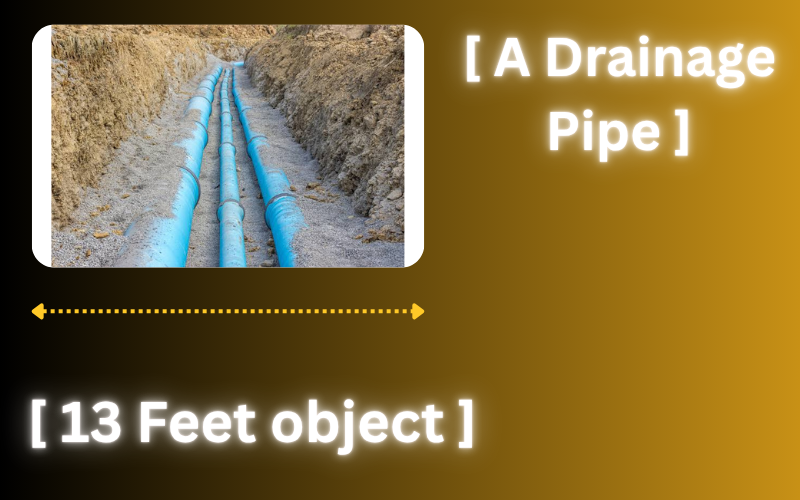
A drainage pipe is another useful example of a long, straight object. Drainage pipes are used in plumbing systems, landscaping, stormwater management, and construction projects to carry water away from buildings and outdoor areas.
A pipe cut to 13 feet would extend almost 4 meters from one end to the other. Because pipes are generally long and narrow, they provide a clear example of length without requiring you to consider a large width or height.
Imagine a drainage pipe laid horizontally along the ground. Its full length would cover a considerable stretch of a garden, driveway, or construction site.
This comparison is helpful when planning drainage installations or estimating the amount of pipe needed for a project. It can also make metric and imperial measurements easier to compare when construction plans use different units.
Drainage pipes come in a wide range of lengths and diameters. Some are sold in shorter sections that connect together, while others may be cut to a specific length on-site.
A pipe measuring 13 feet is therefore a possible example, not a universal standard. For installation work, verify the pipe’s actual length and ensure that the material and diameter are appropriate for the intended drainage system.
The key takeaway is that a 13-foot drainage pipe would stretch nearly 4 meters in a straight line, offering a straightforward visual reference for this measurement.
3. A Large Conference Table
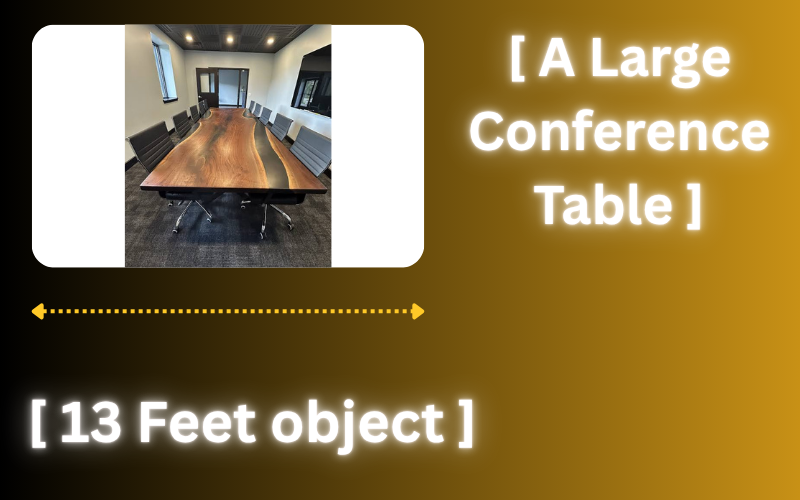
A large conference table can help you imagine 13 feet in an indoor setting. Conference tables are designed for meetings, presentations, discussions, and collaborative work in offices and professional spaces.
Some large conference tables approach 13 feet in length, although many smaller models are significantly shorter. A table near this size can accommodate a substantial meeting area, depending on its width, seating arrangement, and design.
Imagine looking along the length of a long conference table from one end to the other. If it measures approximately 13 feet, the tabletop extends nearly 4 meters through the room.
This comparison is useful when planning a meeting room or deciding how much floor space a large table might require. It also demonstrates that 13 feet is not just a measurement for outdoor objects; it can describe large pieces of indoor furniture as well.
The table’s total dimensions matter when arranging a room. A 13-foot table may need additional space around the edges for chairs, movement, and access to doors or walkways.
Conference tables vary by manufacturer and configuration. Some are rectangular, while others have modular sections that can be connected to create a longer surface.
If you are buying a conference table, check its listed length rather than relying on appearance alone. The table’s width and height should also be considered when determining whether it will suit the available space.
4. A Backyard Zip Line

A backyard zip line can provide another way to visualize a distance of 13 feet, especially in an outdoor recreational setting.
A zip line generally consists of a cable or track arranged between two points. Some backyard recreational systems use relatively short spans, while others cover much longer distances. A 13-foot section of cable provides a useful reference for understanding the measurement, although it should not be assumed to represent the length of a typical complete zip line.
Imagine a straight line extending from one support point to another across part of a backyard. A distance of 13 feet would stretch nearly 4 meters between those points.
This example is helpful because it shows that the same measurement can describe the distance between two locations rather than the length of a solid object.
There is an important distinction between the straight-line distance between supports and the total cable length. A cable may need additional length for its attachment points, slope, tensioning system, and installation requirements.
Backyard zip lines also require appropriate equipment and safe installation. Their dimensions should never be estimated solely by eye when setting up a recreational system. Follow the manufacturer’s specifications and have the installation checked by a qualified adult or professional where appropriate.
For measurement purposes, the useful comparison is simply the span: 13 feet represents a distance of almost 4 meters between two points.
5. A Portable Soccer Goal
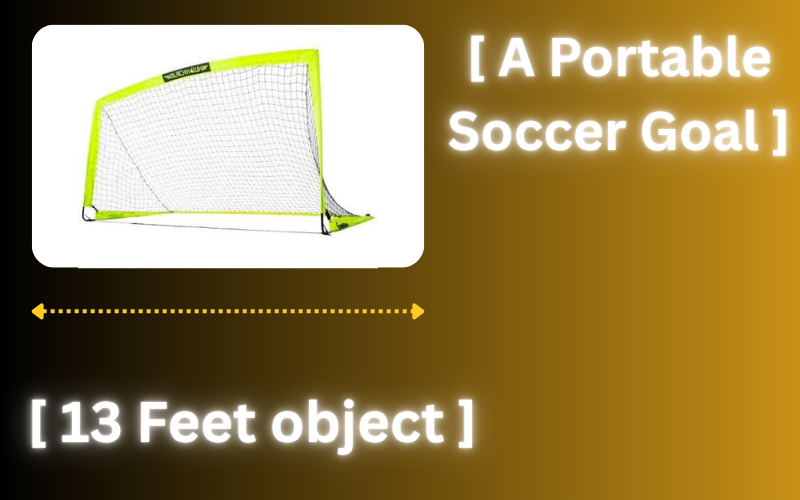
A portable soccer goal is a familiar recreational object that can help illustrate large dimensions, although its actual size depends on the type of goal.
Portable soccer goals are available for backyard games, training sessions, youth sports, and organized play. Some larger recreational models have a width that can approach 13 feet, while smaller training goals may be much narrower.
Imagine a goal standing across a patch of grass. If its width measures around 13 feet, the opening stretches nearly 4 meters from one side to the other.
This gives you a clear way to visualize a horizontal measurement in an outdoor setting. Rather than thinking about the length as a line on a ruler, you can picture the distance spanning an open space.
The goal’s width is different from its height and depth. A product listing may provide all three measurements, so it is important to identify which dimension is being compared.
Portable goals are also manufactured for different age groups and playing environments. A small practice goal may be unsuitable for comparison with a larger recreational goal, even if both are described as portable.
For the most reliable comparison, check the manufacturer’s listed width. A soccer goal that measures close to 13 feet across can serve as a helpful reference, but the dimensions should be verified for the specific model.
6. A Modular Wardrobe System
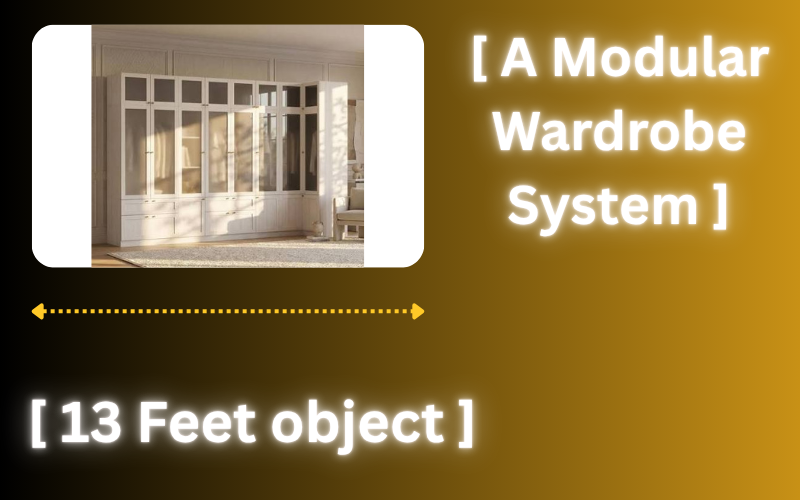
A modular wardrobe system is a useful indoor comparison because its overall length can be adjusted by combining individual storage units.
Modular wardrobes are designed to store clothing, shoes, accessories, and other household belongings. Depending on the number and width of the sections, a connected system may extend across a wall for several feet.
Imagine several wardrobe modules arranged side by side in a bedroom. If their combined width reaches approximately 13 feet, the complete storage system would occupy nearly 4 meters of wall space.
This comparison is especially helpful when planning bedroom storage or organizing a room. It shows how 13 feet can describe the combined width of multiple objects rather than the dimensions of a single item.
A modular system might include hanging compartments, shelves, drawers, and cabinets. The total width depends on the number of modules, the width of each section, and any gaps or trim between them.
The finished installation may also require clearance for doors, drawers, and access to surrounding furniture. Therefore, the usable wall length is not always the only measurement that matters.
Wardrobe systems vary considerably in size, so a 13-foot arrangement should be treated as an example rather than a standard dimension.
When planning a purchase, add the manufacturer’s dimensions for each module and confirm the complete assembled width before ordering.
7. A Fiberglass Ladder
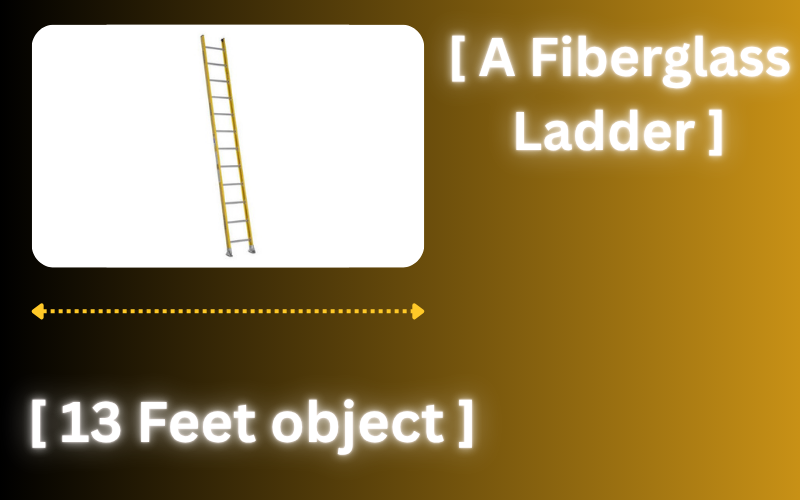
A fiberglass ladder can help you visualize a length close to 13 feet, particularly when thinking about vertical measurements.
Fiberglass ladders are commonly used for maintenance, building work, and other tasks that require access to elevated areas. They are available in multiple lengths and configurations, including step ladders and extension ladders.
Some ladder models have a length around 13 feet, although their usable reach and working height may differ from the ladder’s physical length.
Imagine a ladder placed upright against a wall. A ladder measuring 13 feet from end to end would extend almost 4 meters along its length. This gives you a clear sense of the scale of the measurement when viewed vertically.
However, a ladder’s physical length is not necessarily the same as the height it can safely reach. Extension ladders are positioned at an angle, and their working reach depends on the setup and the user’s height. Step ladders also have different height and reach specifications.
Fiberglass ladders come in different designs, so always check the manufacturer’s measurements. Follow the ladder’s safety instructions, use it on a stable surface, and avoid working near overhead electrical lines.
For visualization, the important point is that a 13-foot ladder is a long piece of equipment that can help you picture a distance of almost 4 meters.
8. A Horse Trailer
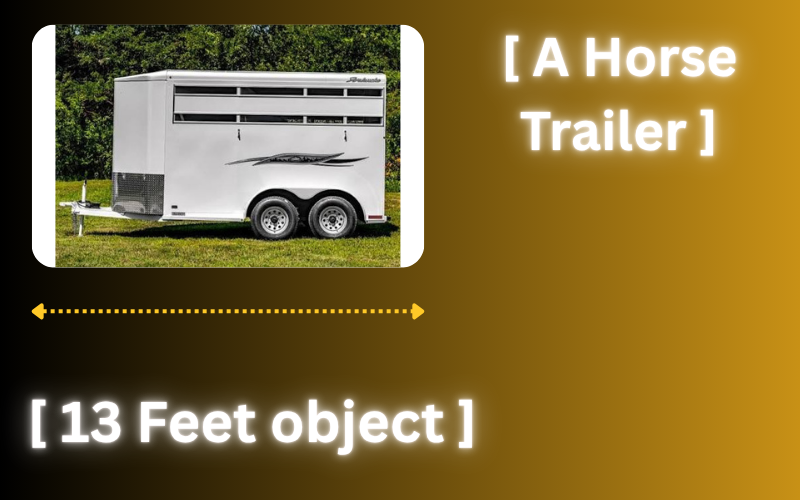
A horse trailer is another large object that can help you visualize 13 feet. These trailers are designed to transport horses and are available in different sizes and configurations.
Some compact horse trailers have dimensions that may approach 13 feet in one of their length measurements. However, the overall length, internal compartment length, and usable floor length can differ significantly between models.
Imagine standing beside a horse trailer and looking along its body. A section measuring approximately 13 feet would stretch almost 4 meters from one end to the other.
This comparison is useful because horse trailers are substantial objects with clearly defined external shapes. Their dimensions can help you understand the amount of space occupied by a large transport structure.
A trailer’s total external length may include the hitch, front section, and rear structure. Its interior length may be shorter, depending on how the trailer is designed.
Horse trailers also vary according to the number of horses they are intended to carry and the amount of storage space included. Consequently, not every horse trailer is close to 13 feet long.
If you need the measurement for parking, storage, or transportation planning, use the exact dimensions provided by the manufacturer. For a general visual reference, a trailer section close to 13 feet illustrates how much horizontal space this length can occupy.
Conversion Table: 13 Feet in Common Measurements
The following table compares 13 feet with several nearby lengths. These values can help you estimate the difference between measurements when planning a room, choosing materials, or comparing product specifications.
| Length in Feet | Inches | Meters | Centimeters |
| 1 foot | 12 inches | 0.3048 m | 30.48 cm |
| 3 feet | 36 inches | 0.9144 m | 91.44 cm |
| 5 feet | 60 inches | 1.524 m | 152.4 cm |
| 8 feet | 96 inches | 2.4384 m | 243.84 cm |
| 10 feet | 120 inches | 3.048 m | 304.8 cm |
| 12 feet | 144 inches | 3.6576 m | 365.76 cm |
| 13 feet | 156 inches | 3.9624 m | 396.24 cm |
| 14 feet | 168 inches | 4.2672 m | 426.72 cm |
| 15 feet | 180 inches | 4.572 m | 457.2 cm |
The difference between 12 feet and 13 feet is one foot, or 12 inches. This can matter when measuring a space with limited clearance or choosing a product that must fit a specific area.
Where Can You Use a 13-Foot Measurement?
Understanding how long 13 feet is can be useful in several everyday situations.
Home and Office Planning
Large conference tables and modular wardrobe systems can occupy considerable space. Knowing the equivalent length of 13 feet can help you estimate whether a furniture arrangement will fit along a wall or within a room.
Construction and Drainage Projects
Drainage pipes and other long materials are often measured in feet, inches, or metric units. Understanding the conversion to meters and centimeters can help you compare measurements on plans and product listings.
Outdoor Recreation
Portable soccer goals and backyard recreational equipment can provide useful visual references for distances across an open area. Always check the exact dimensions of the equipment before purchasing or installing it.
Transportation and Storage
Cargo trailers and horse trailers illustrate why length matters when planning parking and storage. Remember that the total external length may differ from the usable cargo or interior length.
Maintenance and Household Projects
A fiberglass ladder can help you visualize a long vertical measurement. When selecting equipment, distinguish between its physical length, working height, and safe reach.
Conversion Table: Feet to Inches, Yards, and Millimeters
This second table provides additional conversions for common lengths. It is particularly useful when working with product descriptions or plans that use different measurement units.
| Feet | Inches | Yards | Millimeters |
| 2 feet | 24 inches | 0.6667 yd | 609.6 mm |
| 4 feet | 48 inches | 1.3333 yd | 1,219.2 mm |
| 6 feet | 72 inches | 2 yd | 1,828.8 mm |
| 8 feet | 96 inches | 2.6667 yd | 2,438.4 mm |
| 10 feet | 120 inches | 3.3333 yd | 3,048 mm |
| 12 feet | 144 inches | 4 yd | 3,657.6 mm |
| 13 feet | 156 inches | 4.3333 yd | 3,962.4 mm |
| 16 feet | 192 inches | 5.3333 yd | 4,876.8 mm |
| 20 feet | 240 inches | 6.6667 yd | 6,096 mm |
These conversions use standard relationships between feet, inches, yards, and metric units.
“I hope you learned a lot from this article. Check out more articles like this.”
- How Long Is 12 Feet? Discover 8 Everyday Size Comparisons
- How Long Is 11 Feet? Discover 8 Everyday Size Comparisons
- How Long Is 10 Feet? Discover 8 Everyday Size Comparisons
- How Long Is 9 Feet? Discover 8 Everyday Size Comparisons
- How Long Is 8 Feet? Discover 8 Everyday Size Comparisons
FAQs
1. How many inches are in 13 feet?
Thirteen feet equals 156 inches. This conversion is useful when measuring furniture, building materials, and other objects whose dimensions are listed in inches.
2. How many meters is 13 feet?
Thirteen feet equals 3.9624 meters, which is slightly shorter than 4 meters. Thinking of it as almost 4 meters is a convenient way to estimate the length.
3. How many centimeters is 13 feet?
Thirteen feet equals 396.24 centimeters. This is the exact conversion using standard international units.
4. What objects can help me visualize 13 feet?
A small cargo trailer, drainage pipe, large conference table, backyard zip line span, portable soccer goal, modular wardrobe system, fiberglass ladder, and horse trailer can all provide useful comparisons. Their actual dimensions vary, so verify a specific model before treating it as a precise reference.
5. Is 13 feet considered a long measurement?
For household furniture, storage systems, and construction materials, 13 feet is a substantial length. For walking distances, it is relatively short. Whether it feels long depends on the object or space being measured.
6. Is 13 feet the same as 4 meters?
No. Thirteen feet is 3.9624 meters, so it is slightly shorter than 4 meters. The difference is 3.76 centimeters.
7. How can I measure 13 feet without a measuring tape?
You can make a rough estimate by comparing the distance with an object whose dimensions you already know. For accurate results, use a tape measure, measuring wheel, or suitable laser distance meter rather than relying on visual estimates.
8. Why do objects used for comparison have different dimensions?
Manufacturers produce objects in different sizes to suit different purposes, spaces, and users. A cargo trailer, ladder, or conference table may be available in several lengths. That is why the examples in this guide are visual references, not claims that every object measures exactly 13 feet.
Related Posts: How Long Is 12 Feet? Discover 8 Everyday Size Comparisons
Conclusion
Thirteen feet is equal to 156 inches, 3.9624 meters, 396.24 centimeters, and approximately 4.3333 yards. It is a substantial length that can be easier to understand when compared with familiar objects.
A small cargo trailer and a horse trailer illustrate how the measurement applies to transportation. A drainage pipe demonstrates a long, straight dimension, while a large conference table and modular wardrobe system show how 13 feet can occupy a significant portion of an indoor space. A backyard zip line span, portable soccer goal, and fiberglass ladder provide additional ways to picture the measurement outdoors and vertically.
The key is to use these comparisons as practical mental references while remembering that actual product dimensions vary. When accuracy matters for construction, furniture placement, equipment selection, or storage planning, check the manufacturer’s specifications or measure the space directly.

Pingback: How Long Is 14 Feet? Discover 8 Everyday Size Comparisons -
Pingback: How Long Is 15 Feet? Discover 8 Everyday Size Comparisons -
Pingback: How Long Is 18 Feet? Discover 8 Everyday Size Comparisons -