
If you are wondering how long is 26 inches, you may find it difficult to picture the measurement without a familiar reference. Inches are commonly used to describe the dimensions of furniture, appliances, sports equipment, bicycles, household products, and many other things.
26 inches equals 66.04 centimeters, 660.4 millimeters, or 2 feet 2 inches. It is also 2 inches longer than 2 feet, making it a little more than half a meter.
How Long Is 26 Inches?
8 Everyday Objects That Show Its Size
Discover how long 26 inches is with 8 familiar everyday objects. Learn its exact length and visualize this measurement with simple comparisons.
How Long Is 26 Inches?
26 inches is 66.04 centimeters long.
Since one foot contains 12 inches, we can break 26 inches down like this:
12 inches + 12 inches + 2 inches = 26 inches
Therefore:
- 26 inches = 66.04 cm
- 26 inches = 660.4 mm
- 26 inches = 2 feet 2 inches
- 26 inches = 2.1667 feet
- 26 inches = 0.6604 meters
The simplest way to remember the measurement is 2 feet 2 inches.
Another easy reference is 24 inches. Since 24 inches equals exactly 2 feet, 26 inches is simply 2 inches longer than 2 feet.
How Long Is 26 Inches in Centimeters?
Converting 26 inches to centimeters is straightforward because one inch equals exactly 2.54 centimeters.
The calculation is:
26 × 2.54 = 66.04 centimeters
Therefore:
26 inches = 66.04 cm
For a quick estimate, you can think of 26 inches as approximately 66 centimeters.
This also means 26 inches is considerably longer than half a meter. Half a meter is 50 centimeters, so:
66.04 − 50 = 16.04 cm
Therefore, 26 inches is 16.04 centimeters longer than half a meter.
How Long Is 26 Inches in Feet?
There are 12 inches in one foot.
To convert 26 inches into feet:
26 ÷ 12 = 2.1667 feet
So, 26 inches is approximately 2.17 feet.
However, the feet-and-inches version is easier to visualize:
26 inches = 2 feet 2 inches
That means you have two complete feet plus another two inches.
See Also: https://measurezhub.com/
8 Everyday Objects That Are Around 26 Inches
Comparing a measurement with familiar objects can make it much easier to understand.
The following examples are different object types from the comparisons used in the earlier MeasureZHub articles, giving you fresh ways to visualize 26 inches.
Actual dimensions can vary between products and models, so these examples are intended as practical visual references rather than exact specifications unless otherwise stated.
1. A Bicycle Wheel

A bicycle wheel is one of the clearest ways to visualize 26 inches because 26-inch bicycle wheels are a recognized wheel size.
The 26-inch measurement refers to the approximate diameter of the wheel.
Imagine a bicycle wheel standing upright. Measuring straight across its center from one outer edge to the opposite edge gives you a distance of approximately 26 inches.
That means the diameter is about:
26 inches = 66.04 centimeters
This is an excellent comparison because the measurement spans the entire circular wheel, giving you a strong visual reference for the size.
If you have ever seen an older mountain bike or a bicycle with a 26-inch wheel, you can use that wheel as a practical reference for understanding the length.
2. A Medium Microwave Oven
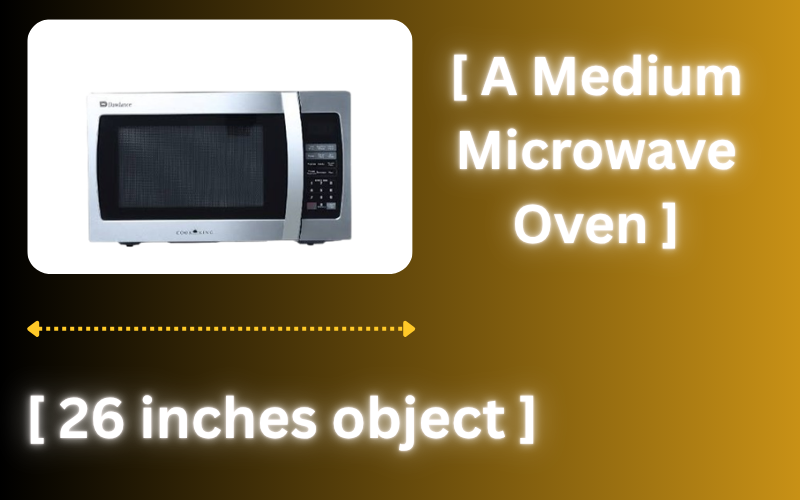
A medium-sized microwave oven can have a width approaching 26 inches.
Microwaves come in many different sizes, so not every model will be 26 inches wide. However, imagining a microwave measuring about 26 inches from side to side provides a useful household comparison.
A 26-inch width equals approximately 66 centimeters.
Picture standing in front of a microwave and measuring horizontally from its left edge to its right edge. A distance of 26 inches would be a little more than two feet.
This makes a microwave a convenient reference when thinking about kitchen appliances and available counter space.
3. A Laundry Hamper

A tall laundry hamper can have a height or width approaching 26 inches, depending on its design.
Imagine a hamper standing on the floor with its top reaching approximately 26 inches above the ground. That would be just over two feet high.
Laundry hampers are useful comparison objects because they are common household items and their overall dimensions are easy to visualize.
A hamper around 26 inches tall would be noticeably taller than many small storage containers while remaining relatively compact.
If you have one at home, measuring its height can give you a physical reference for how far 26 inches extends vertically.
4. A Youth Baseball Bat
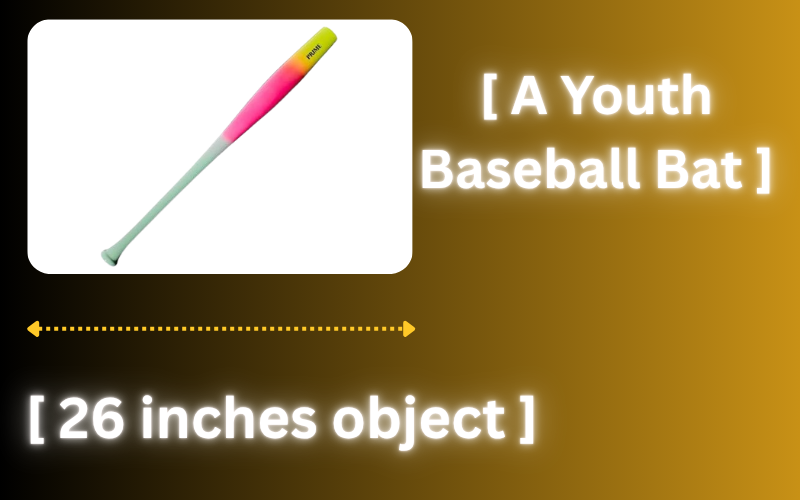
A youth baseball bat can be around 26 inches long.
Baseball bats are manufactured in many different lengths, and 26 inches is a size used for some youth bats.
Imagine placing the bat horizontally on the floor and measuring from the knob at one end to the barrel at the other. A 26-inch bat would extend just over two feet.
This is a particularly useful comparison because the bat is a long, narrow object, making the entire measurement easy to see.
Unlike a large household object, a baseball bat also gives you a clear example of how 26 inches can represent the total length of a handheld item.
5. A Window Blind
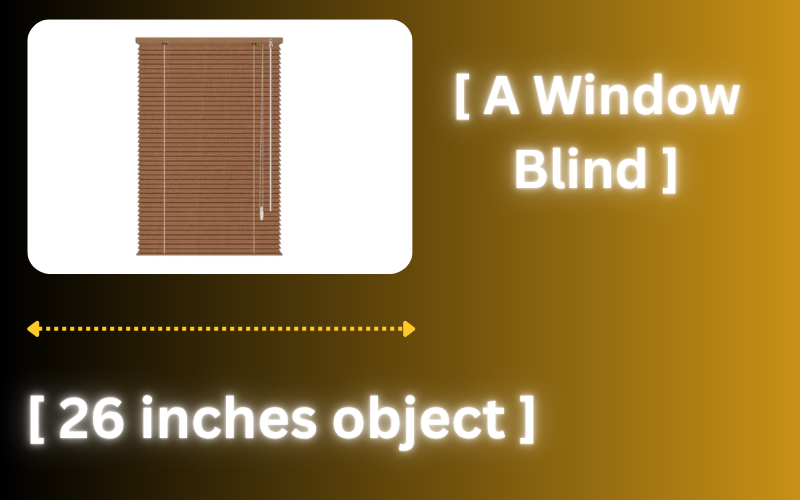
A window blind can have a width of approximately 26 inches.
Blinds are available in many widths, and 26 inches can be a useful size for a relatively narrow window.
Imagine looking at a blind installed inside a window frame. If the blind measures 26 inches from left to right, that width equals approximately 66.04 centimeters.
This gives you a useful way to visualize 26 inches as a horizontal measurement.
A 26-inch blind would cover a smaller window section while still spanning more than two feet across.
6. A Small Aquarium

A compact aquarium can have a length close to 26 inches.
Aquariums come in many shapes and sizes, so the exact dimensions depend on the model. But imagine a rectangular aquarium measuring approximately 26 inches from one end to the other.
That distance would be:
26 inches = 66.04 centimeters
The aquarium comparison is useful because its rectangular shape makes the measurement easy to understand.
If you picture the aquarium sitting on a stand, its length would extend slightly more than two feet across the surface.
7. A Kitchen Cabinet Door

A large kitchen cabinet door can have a dimension approaching 26 inches.
Cabinet doors come in a wide variety of widths and heights, but imagining one side measuring 26 inches gives you another familiar household reference.
Picture measuring from the bottom of a large cabinet door to its top. A 26-inch vertical distance would be approximately 66 centimeters.
This is helpful for understanding that 26 inches does not have to represent the total size of an object. It can also describe one particular dimension, such as height or width.
8. A Large Umbrella When Open

A large umbrella can have an overall open span approaching 26 inches or more, depending on its design.
Imagine measuring across part of the umbrella’s open canopy. A distance of 26 inches would be slightly more than two feet.
Umbrellas provide a useful comparison because their curved canopy makes it easy to appreciate how a measurement can span a substantial distance while still belonging to a relatively portable object.
The exact canopy size varies significantly between compact, standard, and large umbrellas, so use this primarily as a visual reference.
How to Visualize 26 Inches Without a Measuring Tape
You can estimate 26 inches even if you do not have a measuring tape nearby.
The simplest method is to start with 2 feet.
Since:
2 feet = 24 inches
add two more inches:
24 + 2 = 26 inches
You can also use two standard 12-inch rulers.
Two rulers placed end to end equal:
12 + 12 = 24 inches
Then add another 2 inches to reach:
26 inches
Another useful method is to think of a 26-inch bicycle wheel. If you have seen or used one, the distance straight across the wheel gives you an excellent visual reference.
How Long Is 26 Inches Compared to 2 Feet?
This is one of the simplest comparisons.
Two feet equals 24 inches.
Therefore:
26 inches = 2 feet + 2 inches
So, 26 inches is exactly 2 inches longer than 2 feet.
In centimeters:
- 24 inches = 60.96 cm
- 26 inches = 66.04 cm
The difference is:
66.04 − 60.96 = 5.08 cm
Therefore, 26 inches is 5.08 centimeters longer than 2 feet.
Is 26 Inches a Long Measurement?
Whether 26 inches seems long depends on what you are measuring.
For a bicycle wheel, 26 inches represents the full diameter. For a microwave, it could represent the appliance’s width. For a baseball bat, it can represent the entire length.
This shows why the context matters.
For example:
- A 26-inch bicycle wheel is a substantial wheel size.
- A 26-inch microwave width is moderately large.
- A 26-inch baseball bat is compact compared with adult bats.
- A 26-inch window blind is relatively narrow.
- A 26-inch cabinet dimension is useful for many household spaces.
So, 26 inches is neither universally large nor small. Its apparent size depends on the object and the dimension being measured.
26 Inches Compared to 20 Inches
26 inches is 6 inches longer than 20 inches.
In centimeters:
- 20 inches = 50.8 cm
- 26 inches = 66.04 cm
The difference is:
66.04 − 50.8 = 15.24 cm
Therefore, 26 inches is 15.24 centimeters longer than 20 inches.
That is a noticeable difference when comparing two objects side by side.
26 Inches Compared to 24 Inches
26 inches is exactly 2 inches longer than 24 inches.
Since 24 inches equals 2 feet:
26 inches = 2 feet 2 inches
In centimeters:
- 24 inches = 60.96 cm
- 26 inches = 66.04 cm
The difference is 5.08 centimeters.
If you can picture a two-foot measurement, simply adding two inches gives you 26 inches.
26 Inches Compared to 25 Inches
The difference between 25 and 26 inches is exactly one inch.
In centimeters:
- 25 inches = 63.5 cm
- 26 inches = 66.04 cm
Therefore:
66.04 − 63.5 = 2.54 cm
So, 26 inches is 2.54 centimeters longer than 25 inches.
This is a relatively small difference, but it can matter when you are measuring a tight space.
26 Inches Compared to 30 Inches
A 30-inch measurement is 4 inches longer than 26 inches.
In centimeters:
- 26 inches = 66.04 cm
- 30 inches = 76.2 cm
The difference is:
76.2 − 66.04 = 10.16 cm
Therefore, 30 inches is 10.16 centimeters longer than 26 inches.
This gives you another useful reference for understanding where 26 inches falls between common measurements.
26 Inches Compared to Half a Meter
Half a meter equals 50 centimeters.
Since 26 inches equals 66.04 centimeters:
66.04 − 50 = 16.04 cm
Therefore, 26 inches is 16.04 centimeters longer than half a meter.
This means 26 inches is noticeably more than half a meter.
If you can picture a 50-centimeter ruler, imagine extending that length by another 16.04 centimeters to reach 26 inches.
Why Knowing 26 Inches Is Useful
Understanding how long is 26 inches can be useful in many everyday situations.
You may encounter this measurement when:
- Choosing kitchen appliances
- Measuring windows
- Buying sports equipment
- Checking bicycle sizes
- Selecting furniture
- Planning storage space
- Measuring household fixtures
- Comparing product dimensions
For example, if you are shopping for an appliance that is 26 inches wide, knowing that this equals approximately 66 centimeters makes it easier to determine whether it will fit in your kitchen.
Similarly, knowing that 26 inches equals 2 feet 2 inches makes it easier to visualize the measurement without performing a conversion every time.
Quick Conversion Table for 26 Inches
| Measurement | Equivalent |
| Inches | 26 inches |
| Feet | 2.1667 feet |
| Feet & inches | 2 ft 2 in |
| Centimeters | 66.04 cm |
| Millimeters | 660.4 mm |
| Meters | 0.6604 m |
| Yards | 0.7222 yard |
FAQs
Is 26 inches the same as 2 feet?
No. 26 inches equals 2 feet 2 inches, so it is 2 inches longer than 2 feet.
How many centimeters is 26 inches?
26 inches equals 66.04 centimeters.
How many millimeters are in 26 inches?
26 inches equals 660.4 millimeters.
How many feet is 26 inches?
26 inches equals approximately 2.1667 feet, or 2 feet 2 inches.
Is 26 inches more than half a meter?
Yes. 26 inches equals 66.04 centimeters, which is 16.04 centimeters longer than half a meter.
What is the easiest way to visualize 26 inches?
Think of 2 feet plus 2 inches. You can also picture the diameter of a 26-inch bicycle wheel as a practical reference.
Is 26 inches a large measurement?
It depends on the object. For some household items, it is a moderate dimension, while for smaller objects it can be quite large.
What is 26 inches in meters?
26 inches equals 0.6604 meters.
How much longer is 26 inches than 24 inches?
26 inches is 2 inches longer, which equals 5.08 centimeters.
See Also: https://measurezhub.com/
Conclusion
So, how long is 26 inches? The answer is 66.04 centimeters, 660.4 millimeters, or 2 feet 2 inches.
The easiest way to visualize 26 inches is to think of two feet plus two additional inches. It is slightly longer than the 24-inch, two-foot mark and significantly longer than half a meter.
Fresh everyday references such as a 26-inch bicycle wheel, medium microwave, laundry hamper, youth baseball bat, window blind, small aquarium, kitchen cabinet door, and large umbrella can help you picture the measurement from different perspectives.
Whether you are checking an appliance’s dimensions, measuring a window, choosing sports equipment, or simply trying to understand the size of something, remembering that 26 inches is about 66 centimeters and just over two feet gives you a simple and practical reference.