

Five feet is a measurement you may encounter when choosing furniture, planning an office, organizing a balcony, or working on a home improvement project. But how long is 5 feet in everyday terms? If you do not have a measuring tape nearby, comparing this length with familiar objects can help you picture it more easily.
Five feet equals 60 inches, 152.4 centimeters, or 1.524 meters. Imagine a straight line extending from one end to the other for five feet. This gives you a practical reference for estimating the dimensions of objects in your home, workplace, or outdoor space.
How Long Is 5 Feet?
8 Everyday Objects That Show Its Size
Discover how long 5 feet is with 8 familiar everyday objects. Learn its exact length and visualize this measurement with simple comparisons.
How Long Is 5 Feet in Inches and Centimeters?
Five feet equals 60 inches. In the metric system, it measures 152.4 centimeters or 1.524 meters.
Here is a quick conversion table for reference.
| Measurement Unit | Equivalent |
| Feet | 5 feet |
| Inches | 60 inches |
| Centimeters | 152.4 cm |
| Meters | 1.524 m |
| Millimeters | 1,524 mm |
| Yards | Approximately 1.67 yards |
These conversions are useful when comparing product specifications that use different measurement systems. For example, if a furniture listing gives a width of 152.4 centimeters, that dimension is equivalent to five feet.
Is 5 Feet Considered Long?
Five feet is a moderate length for many everyday objects. It is longer than a typical small side table is wide, but shorter than many full-size beds and large dining tables.
Whether five feet seems long depends on the object and the dimension you are measuring. A park bench might be close to five feet wide, while a fishing rod may be considerably longer. An artificial Christmas tree could stand five feet tall, even though its width is much smaller.
It is also important to distinguish length, width, and height. A five-foot-wide object does not necessarily measure five feet from top to bottom. Understanding the direction of measurement helps you make more accurate comparisons.
Related Posts: How Long Is 4 Feet? Discover 8 Everyday Size Comparisons
8 Everyday Objects That Help You Visualize 5 Feet
The following eight objects provide practical ways to picture a five-foot measurement. Some models may be close to five feet in a particular dimension, while others are useful for comparison rather than being exact matches.
1. A Park Bench
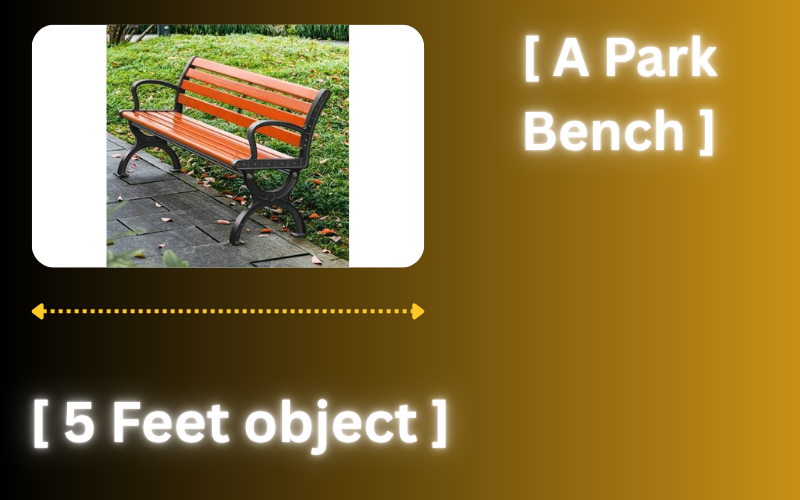
A park bench is a familiar outdoor object that can help you visualize a length of five feet. Many benches are designed to accommodate several people, and compact models may be close to this length.
The most useful dimension to consider is the bench’s overall width, measured from one end to the other along the seating area. If a particular park bench measures 60 inches across, it is exactly five feet wide.
However, park benches come in many sizes. A small garden bench may be shorter, while a longer public bench can measure six feet or more. Armrests and decorative end pieces may also increase the overall width.
This comparison can be especially useful when planning a garden, patio, or outdoor seating area. If you have five feet of available space, a bench with a verified width of 60 inches may fit the opening, although additional clearance may be needed around it.
How to visualize five feet: Picture a compact park bench extending just over four feet across. Check its actual width before using it as an exact five-foot reference.
2. An Office Cubicle Panel

An office cubicle panel can help you understand five feet, particularly when you are planning a workspace or estimating the dimensions of an office partition.
Cubicle panels are manufactured in various heights and widths. Some panels may measure five feet in one dimension, but the exact size depends on the office system, configuration, and intended use.
For this comparison, imagine a cubicle panel that measures 60 inches wide. From its left edge to its right edge, the panel would span exactly five feet.
Some office partitions are approximately five feet tall instead. This distinction matters because a panel’s height and width can be very different. A panel that stands five feet high might be only three or four feet wide.
Office cubicle measurements can also vary depending on whether the manufacturer lists the panel alone or the complete assembly, including connecting hardware and feet.
How to visualize five feet: Imagine a cubicle panel measuring 60 inches from one edge to the other. Check whether the listed dimension refers to its width or height before making comparisons.
3. A Ping-Pong Table Half
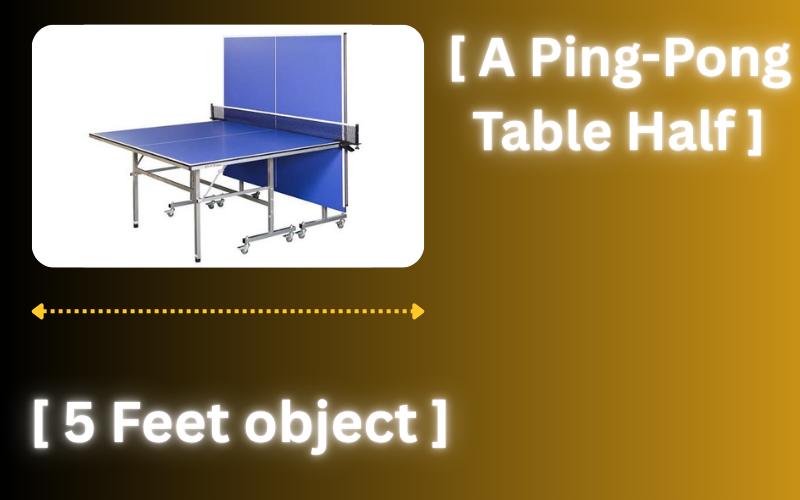
A ping-pong table is a useful reference because it has clearly defined dimensions and a rectangular playing surface. However, a complete standard table is much larger than five feet in length.
A regulation table tennis table measures 9 feet long and 5 feet wide. That means its width is exactly five feet, or 60 inches, when measured across the playing surface.
This makes the table’s width a particularly accurate reference for visualizing five feet. Imagine measuring straight across the shorter side of a standard table tennis table. That distance is five feet.
Although this comparison uses the table’s width, the phrase “ping-pong table half” can refer to one half of the table’s lengthwise playing area. Half the standard table’s length is 4 feet 6 inches, not five feet. Therefore, it is important not to confuse half the table’s length with its full width.
If you are planning space for table tennis, remember that players also need room around the table to move comfortably.
How to visualize five feet: Look at the width of a standard ping-pong table. Its five-foot-wide playing surface gives you a clear reference for the measurement.
4. A Fishing Rod
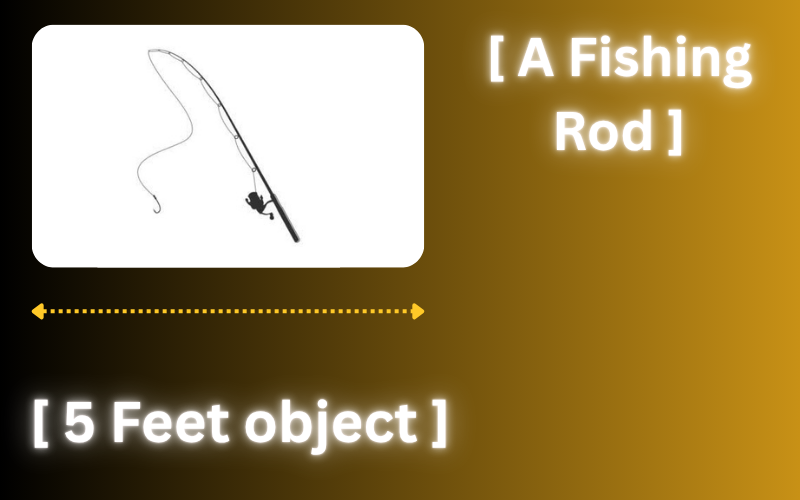
A fishing rod can help you understand five feet, although many common fishing rods are longer than this measurement.
Fishing rods are available in a wide range of lengths depending on the fishing method, target species, and environment. Short rods may measure around five feet, while many spinning, casting, and surf-fishing rods are considerably longer.
A fishing rod that measures 60 inches from its butt end to its tip would be exactly five feet long. However, you should not assume that a rod is five feet just because it looks compact.
When measuring a rod, extend it fully if it is telescopic or assemble its sections according to the manufacturer’s instructions. Measure along the rod from the butt end to the tip rather than measuring the straight-line distance between two points if the rod is curved.
This comparison is useful when selecting fishing equipment or checking whether a rod fits into a storage space. Rod length can affect casting distance, portability, and suitability for different fishing situations.
How to visualize five feet: Imagine a compact fishing rod measuring 60 inches from its handle end to its tip. Check the manufacturer’s listed length because many fishing rods are longer than five feet.
5. A Kayak Paddle

A kayak paddle is another helpful object for visualizing five feet because its total length is measured from one blade tip to the other.
Kayak paddles come in different lengths based on the paddler’s height, kayak width, paddling style, and blade design. Some compact paddles may be near five feet, but many recreational kayak paddles are longer.
If a paddle measures exactly 60 inches from one blade tip to the opposite blade tip, its overall length is five feet. This is a straightforward way to compare the paddle with a familiar measurement.
A paddle’s overall length is different from the length of its shaft or the width of either blade. For an accurate measurement, include the entire paddle from the outer edge of one blade to the outer edge of the other.
This comparison is useful when organizing outdoor gear or checking whether a paddle fits into a storage area. Many paddles can be separated into sections, which may make them easier to transport.
How to visualize five feet: Picture a kayak paddle stretching 60 inches from blade tip to blade tip. Confirm the product’s overall length instead of estimating from its appearance.
6. An Artificial Christmas Tree

An artificial Christmas tree provides a helpful comparison for five feet because tree height is often stated clearly on product packaging.
Artificial Christmas trees are sold in a variety of heights, including compact tabletop versions and full-size floor models. A tree advertised as five feet tall is intended to have a nominal height of 60 inches, although the final measurement may depend on its stand, top branch, and assembly.
When comparing tree heights, check whether the listed measurement includes the stand. Some products specify the height of the tree itself, while others include the complete assembled unit.
The width of a Christmas tree is a separate measurement. A five-foot-tall tree might be narrow and slim or have a broad shape that occupies considerable floor space.
This comparison is especially useful when decorating a small living room, apartment, office, or entryway. A five-foot tree may be a practical option for certain spaces, provided there is enough clearance above it.
How to visualize five feet: Imagine an artificial Christmas tree with a listed height of 60 inches. Measure from the floor to its highest point to confirm the actual assembled height.
7. A Balcony Railing Section
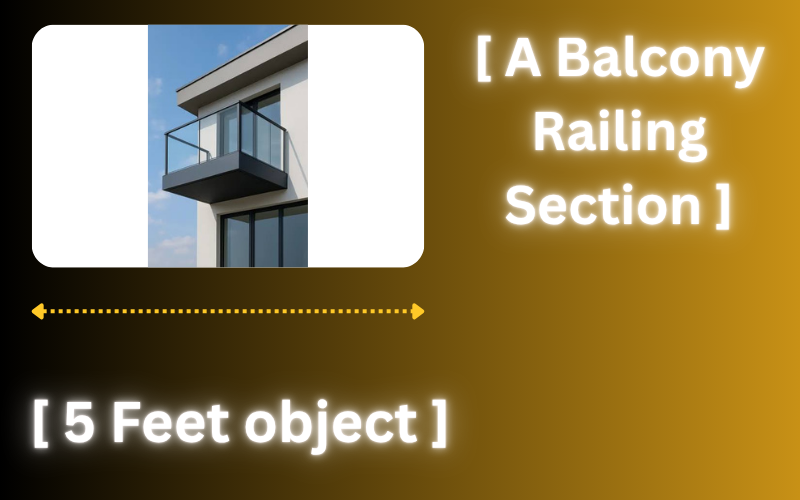
A balcony railing section can help you picture five feet when you consider the length of a section running horizontally along the balcony.
Balcony railings are built in many configurations. Some are installed in separate sections, while others extend continuously along the edge. The length of each section depends on the balcony layout and construction requirements.
A railing section measuring 60 inches from one end to the other would be five feet long. This makes it a useful comparison when estimating the length of a balcony edge or planning a railing replacement.
However, railing height and section length are different dimensions. A railing may extend five feet horizontally while standing at a different height. Never assume the length of a railing section from its appearance alone.
For any balcony project, follow applicable building codes and manufacturer requirements. Railing height, spacing, structural strength, and installation all have safety implications, so visual estimates are not a substitute for professional measurements.
How to visualize five feet: Imagine a straight section of balcony railing extending 60 inches horizontally. Confirm its actual length and follow the relevant safety requirements if you are planning an installation.
8. A Six-Drawer Dresser

A six-drawer dresser can provide a useful furniture comparison for five feet, particularly when looking at its width.
Dressers are available in many styles and sizes. Some six-drawer models are designed with two rows of three drawers and may be close to five feet wide. Others are significantly narrower or wider, depending on the drawer arrangement and overall design.
If a dresser measures 60 inches from its left outer edge to its right outer edge, its width is exactly five feet. This measurement can help you plan a bedroom layout, organize storage, or determine how much wall space the furniture will occupy.
The dresser’s height and depth are separate measurements. A wide, low dresser can have a width of five feet without being especially tall, while a taller dresser may be much narrower.
Before purchasing a dresser, check the overall dimensions and account for any handles or other components that extend beyond its main body. You should also leave enough clearance for the drawers to open fully.
How to visualize five feet: Picture a dresser spanning 60 inches across its front. Check the manufacturer’s width specification to see whether a particular six-drawer model matches this measurement.
How to Convert 5 Feet Into Other Measurements
Converting five feet into other units makes it easier to compare objects and understand product dimensions.
Five feet equals 60 inches and 152.4 centimeters. It is also 1.524 meters. These values are useful when measurements are provided in different systems.
The table below includes five feet and several nearby measurements for quick comparison.
| Feet and Inches | Total Inches | Centimeters |
| 4 feet | 48 inches | 121.92 cm |
| 4 feet 6 inches | 54 inches | 137.16 cm |
| 5 feet | 60 inches | 152.4 cm |
| 5 feet 6 inches | 66 inches | 167.64 cm |
| 6 feet | 72 inches | 182.88 cm |
For example, an item measuring 152.4 centimeters is five feet long. An item measuring 182.88 centimeters is six feet long, which is one foot longer than the five-foot reference.
Practical Tips for Measuring Five Feet at Home
If you need to confirm whether an object measures five feet, a measuring tape is the simplest tool to use.
- Find the starting point. Place the zero mark at the edge where you want the measurement to begin.
- Extend the tape to 60 inches. Five feet equals 60 inches, so look for that mark on the tape.
- Keep the tape straight. Measure along the object’s length, width, or height without bending the tape across the space.
- Check the correct dimension. A five-foot-wide object may not be five feet tall or deep.
- Measure the complete object. Include handles, frames, feet, or other projecting parts if you need the overall exterior dimensions.
If you only have a short ruler, you can reposition it along the object and add each section together. Keep the ruler aligned carefully to avoid gaps or overlaps that could affect the final result.
When buying furniture, office equipment, or outdoor accessories, check the manufacturer’s specifications for accurate dimensions. Everyday comparisons are helpful for estimating, but an actual measurement is more reliable when an object must fit into a particular space.
“I hope you learned a lot from this article. Check out more articles like this.”
- How Long Is 4 Feet? Discover 8 Everyday Size Comparisons
- How Long Is 3 Feet? Discover 8 Everyday Size Comparisons
- How Long Is 2 Feet? Discover 8 Everyday Size Comparisons
- How Long Is 1 Feet? Discover 8 Everyday Size Comparisons
- How Long Is 50 Inches? Discover 8 Everyday Size Comparisons
FAQs
1. How long is 5 feet in inches?
Five feet equals 60 inches. Since one foot contains 12 inches, five feet contains 60 inches in total.
2. How many centimeters are in 5 feet?
Five feet equals 152.4 centimeters, or 1.524 meters.
3. Is 5 feet longer than 1 meter?
Yes. Five feet measures 1.524 meters, which is 52.4 centimeters longer than one meter.
4. What everyday objects can help me visualize 5 feet?
A park bench, office cubicle panel, ping-pong table half, fishing rod, kayak paddle, artificial Christmas tree, balcony railing section, and six-drawer dresser can help you picture this measurement. Their dimensions vary, so check the actual measurements before treating any object as an exact five-foot example.
5. Is a ping-pong table 5 feet wide?
Yes. A standard regulation table tennis table is 5 feet wide and 9 feet long. Its width provides a useful, well-defined comparison for visualizing five feet.
6. Can an artificial Christmas tree be exactly 5 feet tall?
Yes. Artificial Christmas trees are sold in nominal five-foot heights. However, the actual assembled height can depend on the stand, top branch, and how the manufacturer specifies its measurements.
7. Why is knowing the length of 5 feet useful?
Knowing this measurement can help with furniture shopping, office planning, outdoor projects, equipment storage, and estimating the dimensions of household objects.
Related Posts: How Long Is 4 Feet? Discover 8 Everyday Size Comparisons
Conclusion
Five feet equals 60 inches, 152.4 centimeters, or 1.524 meters. It is a useful reference for visualizing furniture, outdoor equipment, office partitions, and other everyday items.
A park bench, office cubicle panel, ping-pong table half, fishing rod, kayak paddle, artificial Christmas tree, balcony railing section, and six-drawer dresser each offer a different way to understand this length. Some may measure close to five feet in a particular dimension, while others are simply useful comparisons.
For a quick estimate, imagine a straight line extending 60 inches. When accuracy matters, use a measuring tape and verify the object’s actual length, width, or height rather than relying on appearance alone.

Pingback: How Long Is 6 Feet? Discover 8 Everyday Size Comparisons -