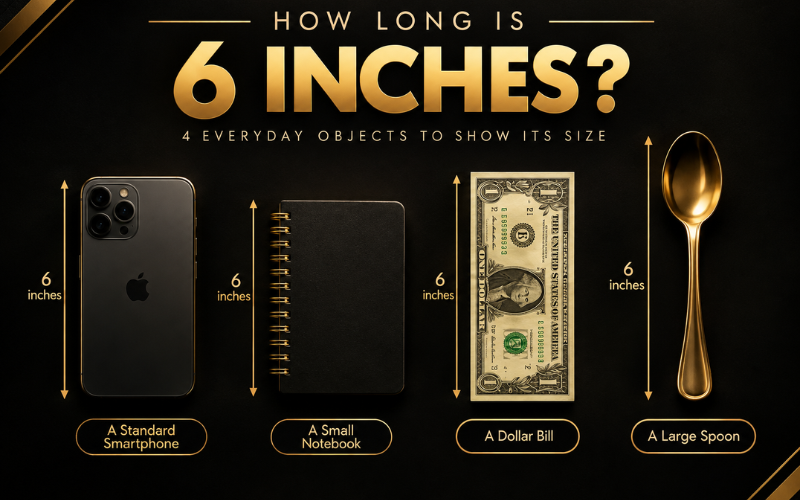
Have you ever wondered how long 6 inches actually is? Whether you are measuring an object, shopping online, working on a DIY project, or simply trying to understand a measurement, knowing what 6 inches looks like can be surprisingly useful. Although six inches is a common measurement, it can be difficult to visualize without a ruler or measuring tape.
So, how long is 6 inches? Six inches is equal to half a foot, 15.24 centimeters, or 152.4 millimeters. It is approximately the length of several small household objects and everyday items.
How Long Is 6 Inches?
8 Everyday Objects That Show Its Size
Discover how long 6 inches is with 8 familiar everyday objects. Learn its exact length and visualize this measurement with simple comparisons.
How Long Is 6 Inches in Different Measurements?
Before looking at everyday objects, let’s understand the basic conversions for six inches.
| Measurement | Equivalent |
|---|---|
| Inches | 6 inches |
| Centimeters | 15.24 cm |
| Millimeters | 152.4 mm |
| Feet | 0.5 feet |
| Meters | 0.1524 m |
Six inches is exactly half of one foot. In the metric system, it is 15.24 centimeters. These conversions are useful when following instructions or comparing products that use different measurement systems.
For example, if an online product listing says an item is 15.24 cm long, that is exactly the same as 6 inches.
See Also: https://measurezhub.com/
8 Everyday Objects That Help You Visualize 6 Inches
Here are eight familiar objects that can help you estimate the length of six inches. Keep in mind that object sizes vary by brand, design, and model, so these are visual references rather than exact measuring tools.
1. A Standard Smartphone

A smartphone is a familiar object that can help you imagine measurements around six inches. Some smartphones have a body length close to this measurement, although modern models vary considerably in size.
If you have a smartphone nearby, you can compare its length with a six-inch ruler. Some phones will be shorter, while others will be longer. Remember that a phone’s advertised screen size is measured diagonally, not from top to bottom.
Why it helps: A smartphone is an easy reference when you are shopping for phone accessories, comparing devices, or trying to picture a measurement without a ruler.
2. A Small Notebook

A small notebook is another useful object for visualizing six inches. Pocket notebooks and compact notepads come in different dimensions, and some have a length close to 6 inches.
Imagine holding a small notebook in your hand. Its longer edge may give you a helpful idea of how much space six inches takes up. However, not every pocket notebook has the same measurements, so check its dimensions if accuracy matters.
Why it helps: Notebooks are useful references when measuring desk accessories, stationery, small bags, and storage compartments.
3. A Dollar Bill

A United States dollar bill is a particularly useful comparison because it measures approximately 6.14 inches long. This makes it slightly longer than six inches, with a difference of just 0.14 inches.
If you have a dollar bill, place it flat on a table and imagine removing a very small amount from one end. The remaining length would be close to six inches.
This comparison works well because the bill has a consistent standard size. It is a practical reference when you want to estimate six inches without carrying a ruler.
Why it helps: A dollar bill provides a close, familiar reference for visualizing a length slightly above six inches.
4. A Large Spoon
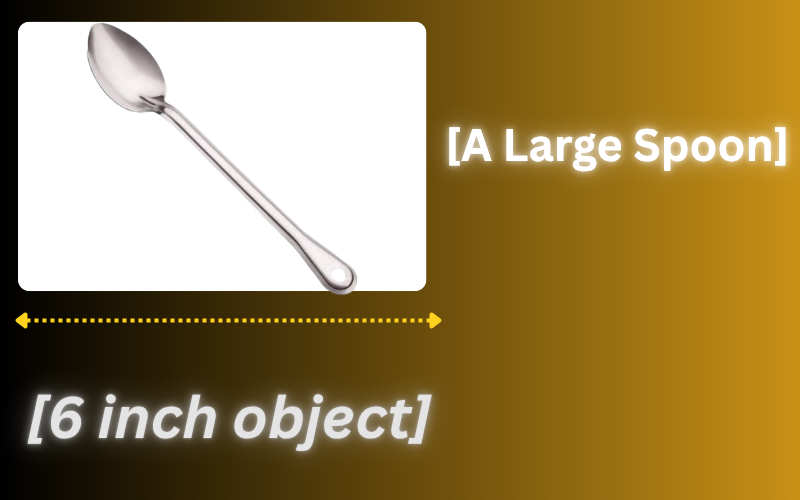
Some large dining spoons measure around six inches from the tip of the bowl to the end of the handle. Their exact dimensions depend on their design, but they can provide a useful household comparison.
Take a large spoon from your kitchen and look at its full length. If it is close to six inches, you can use it as a visual reference when estimating the size of other objects.
A teaspoon, on the other hand, is often shorter, so it is important not to assume that every spoon has the same length.
Why it helps: A large spoon is easy to find at home and provides a convenient way to understand the approximate length of six inches.
5. A Short Pencil
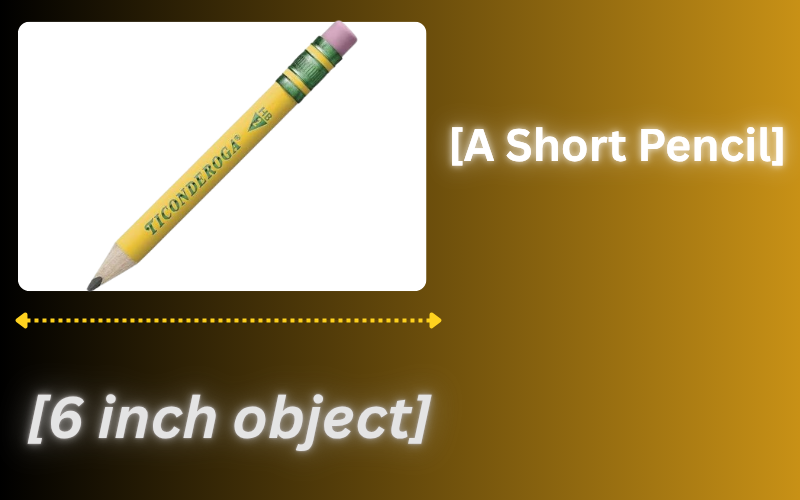
A short pencil can also help you picture six inches. Many standard pencils are longer than six inches when new, but shorter pencils, especially those that have been sharpened repeatedly, may be close to this measurement.
Place a short pencil on a flat surface and compare it with a ruler if one is available. Once you know its approximate length, you can remember it as a reference for future measurements.
Pencils are especially useful examples because their shape makes their length easy to see. Just remember that a new pencil and a shortened pencil can differ considerably.
Why it helps: A short pencil is a practical visual reference for stationery, pencil cases, and small school supplies.
6. A Small Hairbrush
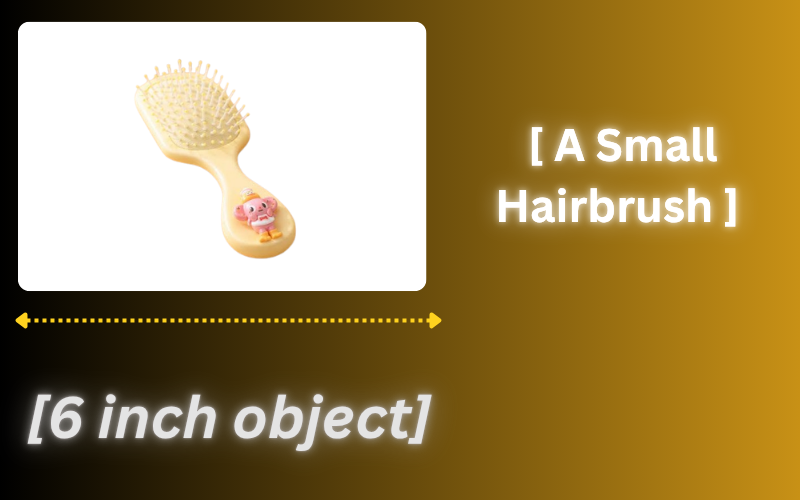
A compact hairbrush may have a length close to six inches, depending on its design. Travel-size brushes are particularly useful for this comparison because they are made to fit into small bags and cases.
Look at the handle and brush head together rather than measuring only the bristled section. The total length is what matters when comparing the brush with a six-inch measurement.
Not all travel brushes are the same size, but a compact model can help you visualize the general scale of this measurement.
Why it helps: A small hairbrush is a useful reference when considering travel accessories, cosmetic bags, and compact storage spaces.
7. A TV Remote Control

Some compact TV remote controls are around six inches long. Larger remotes can be noticeably longer, while smaller ones may be shorter.
If you have a remote control at home, place it on a table and look at its length. A compact remote can provide a convenient way to imagine how much space six inches occupies.
This comparison is particularly helpful when organizing drawers, planning storage, or estimating whether a small electronic accessory will fit inside a particular space.
Why it helps: A compact remote is a familiar household object that can make six inches easier to picture.
8. A Small Ruler
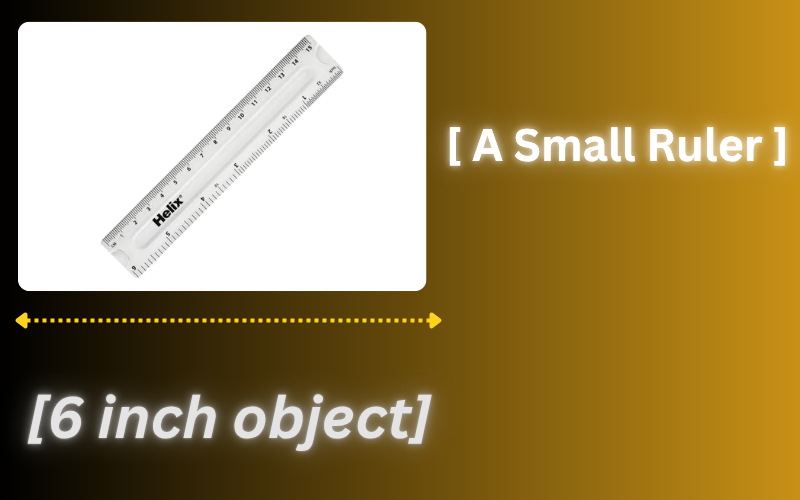
A ruler is the most direct way to understand six inches. On a standard 12-inch ruler, the six-inch mark is exactly halfway between zero and twelve.
If you have a 12-inch ruler, place it on a flat surface and find the halfway point. The distance from the zero mark to the six-inch mark is exactly six inches.
Unlike everyday objects, a ruler gives you a precise measurement rather than an estimate. You can use it to check the sizes of the other objects in this list and see which ones are closest to six inches.
Why it helps: A ruler is a reliable reference for school projects, crafts, DIY work, and checking product dimensions.
How to Estimate 6 Inches Without a Ruler
If you do not have a ruler, you can still make a rough estimate by using familiar objects. The key is to remember that comparisons are useful for visualization, but they are not substitutes for precise measurement.
Here are a few simple approaches:
- Use a familiar object: Compare the item with a small notebook, compact remote, or other object whose length you have checked before.
- Remember half a foot: Six inches is exactly half of twelve inches, making the midpoint of a standard foot-long ruler a useful reference.
- Think in centimeters: Remember that six inches equals 15.24 cm. This can help if you are more familiar with metric measurements.
- Check your estimate: When accuracy matters, use a ruler or measuring tape rather than relying on appearance.
For online shopping, measuring the actual space where an object will go is particularly helpful. Product photos can make items appear larger or smaller than they really are.
Why Is Knowing the Length of 6 Inches Useful?
Understanding six inches can help in many everyday situations. You might encounter this measurement when buying stationery, organizing a desk, comparing electronic accessories, or following instructions for a craft project.
For example, a product described as six inches long might fit into a particular drawer, but its width and thickness also matter. Checking all three dimensions can help you avoid choosing an item that does not fit.
Six inches is also a convenient measurement for learning about the relationship between inches and centimeters. When you remember that one inch equals 2.54 cm, converting other measurements becomes easier.
For more precise tasks, always check the stated dimensions rather than assuming that an everyday object is an exact six inches long.
FAQs
1. How long is 6 inches in centimeters?
Six inches is exactly 15.24 centimeters. To convert inches into centimeters, multiply the number of inches by 2.54.
2. Is 6 inches half a foot?
Yes. Six inches is exactly half a foot because one foot contains twelve inches.
3. How long is 6 inches compared to a ruler?
On a standard 12-inch ruler, six inches reaches the exact midpoint. It covers half of the ruler’s total length.
4. What everyday objects are close to 6 inches?
A compact smartphone, small notebook, large spoon, short pencil, compact hairbrush, or small remote may be close to six inches, depending on the specific item.
5. How many millimeters are in 6 inches?
Six inches equals 152.4 millimeters. Multiply six by 25.4 to get the result.
6. Can I measure 6 inches using my hand?
You can use your hand for a rough estimate, but hand dimensions vary from person to person. If you need an accurate measurement, use a ruler or measuring tape.
7. Is 6 inches the same as 15 cm?
They are very close, but not exactly equal. Six inches is 15.24 cm, which is 0.24 cm longer than 15 cm.
8. How can I remember the length of 6 inches?
The easiest way is to remember that six inches is half a foot and equals 15.24 cm. You can also memorize the approximate length of a familiar object after checking it with a ruler.
See Also: https://measurezhub.com/
Conclusion
So, how long is 6 inches? It is exactly 15.24 centimeters, 152.4 millimeters, or half a foot. Although the number may seem difficult to visualize at first, comparing it with familiar household objects makes the measurement easier to understand.
A compact smartphone, small notebook, large spoon, short pencil, hairbrush, and remote control can all serve as approximate visual references. A dollar bill is another helpful comparison because it is slightly longer than six inches. For exact measurements, however, a ruler remains the most reliable option.
The next time you encounter a six-inch measurement while shopping, studying, or working on a project, you will have a better idea of the length and how it compares with everyday objects.