

Eight feet is a useful measurement to understand when estimating the length of furniture, planning a room layout, measuring outdoor spaces, or working on home improvement projects. However, it can be difficult to picture this length if you do not have a measuring tape nearby.
So, how long is 8 feet? Eight feet equals 96 inches, 243.84 centimeters, or approximately 2.44 meters. It is about the length of a large piece of furniture, a section of metal pipe, or a measured portion of a longer object.
How Long Is 8 Feet?
8 Everyday Objects That Show Its Size
Discover how long 8 feet is with 8 familiar everyday objects. Learn its exact length and visualize this measurement with simple comparisons.
How Long Is 8 Feet in Different Measurements?
Before comparing everyday objects, it helps to understand how 8 feet translates into other common units.
| Unit of Measurement | Equivalent to 8 Feet |
| Feet | 8 feet |
| Inches | 96 inches |
| Centimeters | 243.84 cm |
| Meters | 2.4384 meters |
| Yards | 2.67 yards |
Eight feet is slightly less than 2.5 meters. If you use the metric system, imagining a length of approximately 2.44 meters is a convenient way to estimate it.
For example, you can visualize this distance across a room, along a garden walkway, or beside a long piece of furniture. Remember that these comparisons are for estimation rather than precise measurement.
Related Posts: How Long Is 7 Feet? Discover 8 Everyday Size Comparisons
8 Everyday Objects That Help You Visualize 8 Feet
The following eight objects provide different ways to understand an 8-foot length. Some can be close to this measurement in their actual dimensions, while others are longer or shorter and work best as reference points.
1. A Volleyball Net
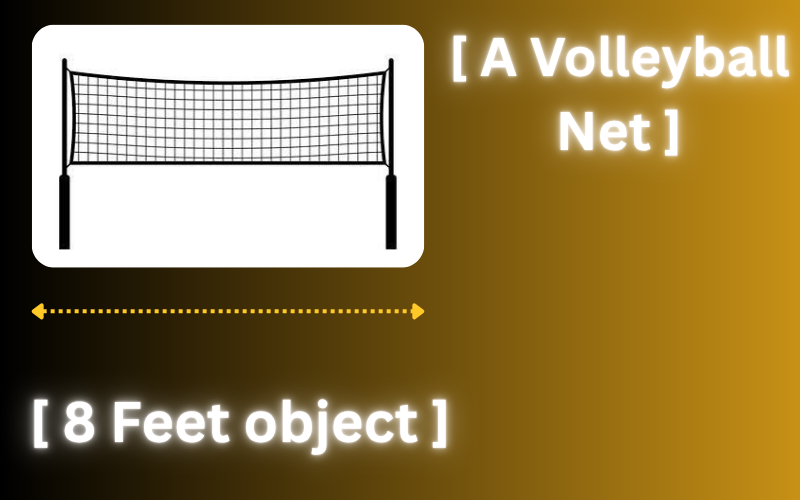
A volleyball net is a useful object for understanding measurements because it stretches horizontally across a playing court. Although the net itself is considerably longer than 8 feet, its height provides an interesting comparison.
In standard indoor volleyball, the top of the net is positioned approximately 7 feet 11 5/8 inches above the floor for men’s competitions. This is extremely close to 8 feet.
Women’s indoor volleyball uses a lower net height of approximately 7 feet 4 1/8 inches.
To visualize 8 feet, imagine the height of a men’s indoor volleyball net measured from the floor to its top edge. The difference between the official height and 8 feet is only 3/8 of an inch.
That small difference makes the net a particularly helpful reference for understanding a vertical distance of 8 feet.
Keep in mind that the net’s total horizontal length is much greater than 8 feet. Its height, rather than its full length, is the relevant comparison here.
Practical comparison: Picture a vertical line extending from the floor to the top of a standard men’s volleyball net. That distance is almost exactly 8 feet.
2. An Outdoor Picnic Table
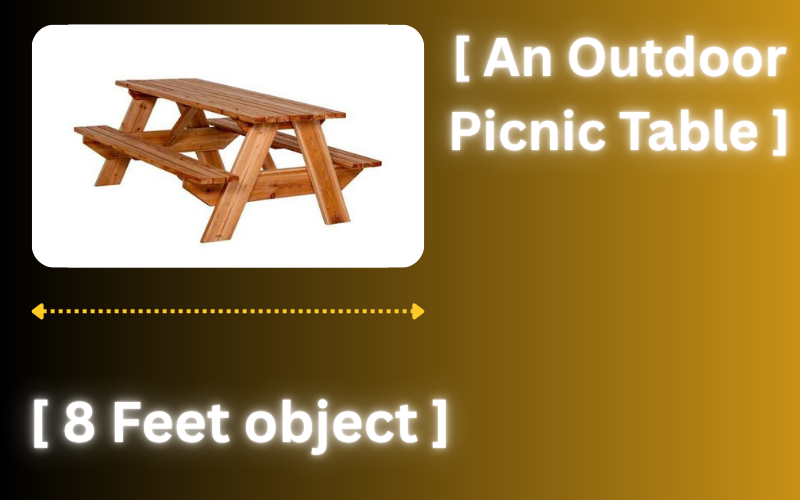
A long outdoor table can help you picture an 8-foot horizontal distance.
An outdoor picnic table is another practical reference for visualizing length. These tables are commonly found in parks, gardens, campgrounds, and outdoor dining areas.
Picnic tables come in many sizes. Smaller models may be designed for four people, while longer versions can accommodate six, eight, or more people. Some full-size outdoor picnic tables are approximately 8 feet long.
An 8-foot picnic table measures 96 inches from one end of the tabletop to the other. This gives you a convenient real-world example of the measurement.
Imagine standing at one end of a long picnic table and looking toward the opposite end. If the table measures 8 feet, the distance across its length represents the measurement you are trying to understand.
However, not every picnic table is 8 feet long. Many residential models are shorter, so checking the product specifications is important if you need an accurate comparison.
Practical comparison: An outdoor picnic table that measures 96 inches long provides a direct example of an 8-foot distance.
3. A Roll of Electrical Wire
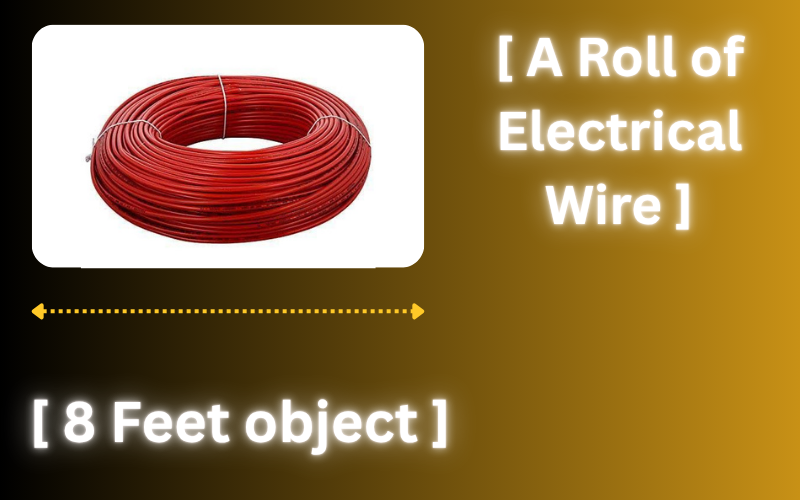
Electrical wire is useful for visualizing 8 feet because it can be measured and laid out in a straight line. Unlike furniture, which has fixed dimensions, wire can be cut to the exact length required for a project.
Electrical wire is sold in different lengths, depending on the type of cable, its intended use, and the packaging. A roll or coil generally contains much more than 8 feet of wire.
To picture this measurement, imagine pulling 8 feet of wire from a coil and laying it straight along the floor. The resulting line would extend 96 inches from its starting point.
You could use this method to estimate distances between electrical components, plan a suitable cable route, or understand the amount of wire required for a small project.
Remember that the length of the wire is not the same as the overall size of the coil. Wire wound into a compact roll occupies much less space than the same length stretched out.
For electrical work, always choose the correct cable type and follow applicable safety requirements. A visual estimate is not a substitute for accurate measurement or professional guidance.
Practical comparison: Straighten an 8-foot section of electrical wire along the floor to see how far 96 inches extends.
4. A Two-Seater Kayak
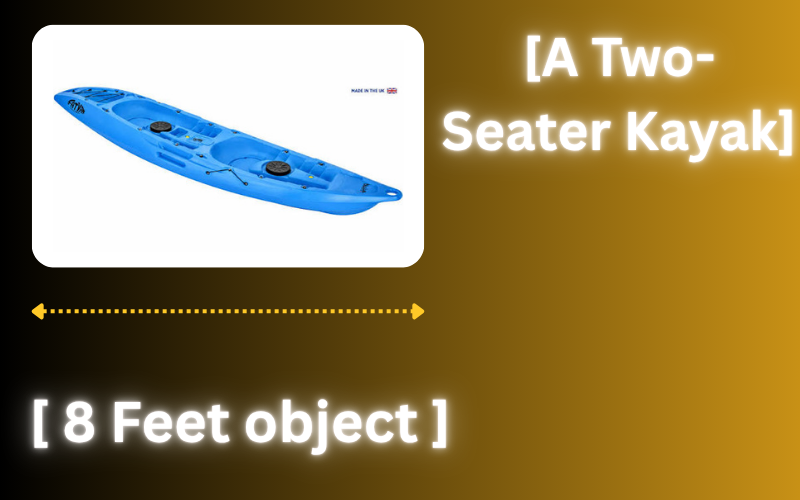
A two-seater kayak offers another way to understand an 8-foot measurement, although most tandem kayaks are longer than this.
Kayaks designed for two people need enough space for two seating positions, legroom, and the structure required for safe movement through the water. As a result, many tandem models measure approximately 10 to 14 feet long, with some falling outside that range.
An 8-foot section represents only part of the length of a typical two-person kayak.
For example, imagine a tandem kayak that measures 12 feet from bow to stern. An 8-foot distance would cover two-thirds of its overall length.
This comparison can be helpful when looking at kayaks in a store, browsing product specifications, or estimating the length of outdoor equipment.
It is important not to assume that every kayak has the same dimensions. Compact recreational kayaks, single-person models, and specialized designs may have different lengths.
Practical comparison: Imagine measuring from the front of a longer tandem kayak toward the back. An 8-foot section would cover a substantial portion of the vessel but would not usually reach the opposite end.
5. A Freestanding Punching Bag

A freestanding punching bag can help you visualize height, particularly when you compare it with an imaginary 8-foot line extending upward from the floor.
These training bags are available in different shapes and sizes. Many include a striking surface mounted on a weighted base, and their overall height varies according to the model and intended user.
A typical freestanding punching bag may be considerably shorter than 8 feet. This makes it more useful as a reference point than as an exact example of the measurement.
Imagine placing a vertical measuring line beside the bag that extends 8 feet above the floor. Depending on the model, the line may rise well above the top of the punching surface.
This comparison is especially useful when planning a home gym, checking ceiling clearance, or deciding whether an area has enough vertical space for different types of training equipment.
Do not confuse the bag’s height with its width or the diameter of its base. These dimensions describe different aspects of the product.
Practical comparison: Picture a vertical distance of 96 inches beside a freestanding punching bag. The 8-foot line will generally extend above the top of many standard home models.
6. A Metal Pipe
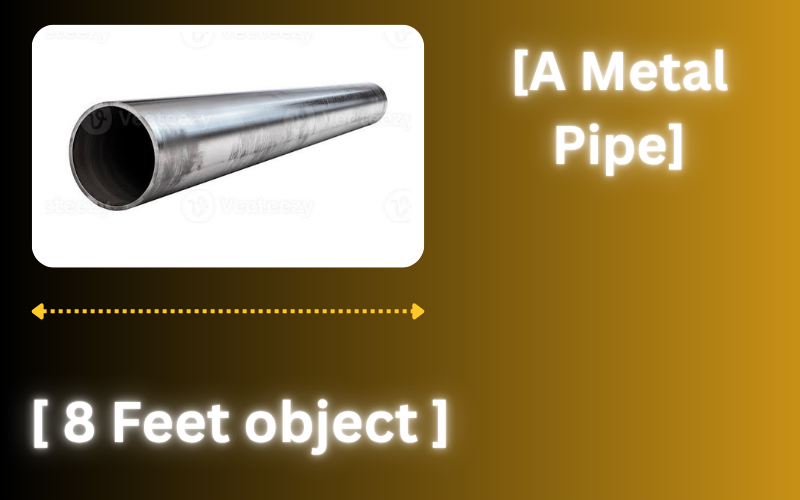
A metal pipe is one of the simplest objects for visualizing an exact 8-foot length because it can be manufactured or cut to a specified dimension.
Metal pipes are used in plumbing, construction, industrial equipment, fencing, and various home improvement projects. They come in different materials, including steel, copper, and other metal alloys, depending on their purpose.
An 8-foot pipe measures 96 inches from one end to the other. If you place it horizontally on a flat surface, you can see the full length represented in a straight line.
Unlike a picnic table or a kayak, a pipe can be ordered in a specific length. However, pipes are also sold in a variety of standard and custom sizes, so not every pipe will measure 8 feet.
When purchasing a pipe, remember that nominal pipe size usually refers to a standardized diameter designation rather than the pipe’s actual outside diameter. Its length is a separate measurement.
If you need a pipe for a project, check the specified length, diameter, material, and intended application before buying it.
Practical comparison: An 8-foot metal pipe laid horizontally provides a direct example of a 96-inch length.
7. A Poolside Lounger
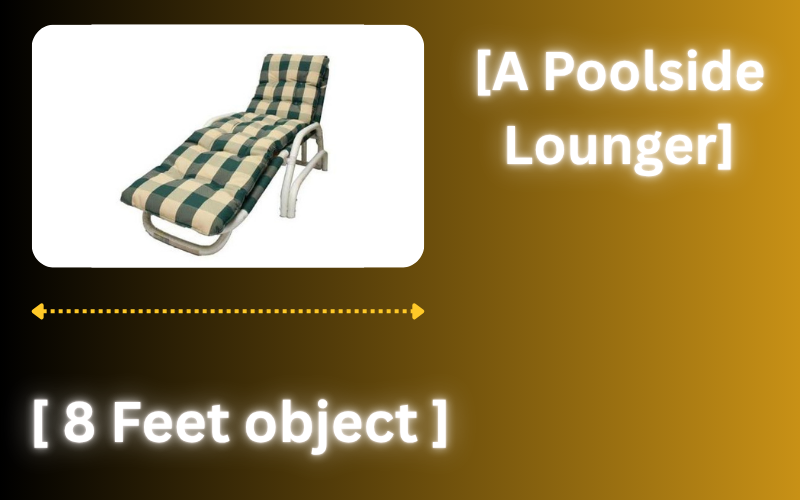
A poolside lounger is a familiar piece of outdoor furniture that can help you estimate long distances. These chairs are commonly used beside swimming pools, on patios, and in outdoor relaxation areas.
Most poolside loungers are designed to support one person in a reclining position. Their overall length varies depending on the frame, backrest design, and whether the footrest extends.
Many loungers are shorter than 8 feet, although dimensions differ between models. Therefore, a lounger is best treated as a familiar reference rather than an exact 8-foot object.
Imagine placing a measuring tape along the lounger from its head end to its foot end. If the model measures around 6 to 6.5 feet, an 8-foot distance would extend roughly 1.5 to 2 feet beyond it.
This makes a poolside lounger useful for understanding the difference between a length that is a little over 6 feet and one that reaches 8 feet.
The comparison can also help when arranging outdoor furniture. For instance, an 8-foot space may be enough for the length of a lounger plus some additional room, depending on the design and layout.
Practical comparison: Visualize a typical poolside lounger, then imagine extending its length by another 1.5 to 2 feet to approach 8 feet.
8. A Metal Bed Frame

A metal bed frame is another familiar household object that can help you picture a length close to 8 feet, especially when considering the frame’s overall dimensions.
Bed frames are made in different sizes to support different mattress types. Their length depends on the mattress they are designed for, along with the frame’s construction and any decorative extensions.
For reference, a standard twin mattress is typically about 75 inches long, while many full, queen, and king mattresses are approximately 80 inches long. These mattress lengths are shorter than 96 inches.
An 8-foot measurement is therefore longer than the length of many standard mattresses. A metal bed frame may extend beyond its mattress, but its exact overall length depends on the model.
Imagine measuring from the head end of a bed frame to its foot end. On a frame designed for an 80-inch mattress, the difference between the mattress length and 8 feet is 16 inches.
This is a useful way to understand how 8 feet compares with the length of common bedroom furniture.
Before buying a frame, check the product’s external dimensions rather than relying only on the mattress size. The overall frame may require more floor space than the mattress itself.
Practical comparison: An 80-inch mattress is 16 inches shorter than 8 feet, giving you a clear reference for understanding the difference.
How to Visualize 8 Feet Without a Measuring Tape
If you do not have a tape measure available, several simple methods can help you estimate an 8-foot distance.
Use a known object. Compare the distance with an object whose dimensions you already know, such as a measured picnic table or a metal pipe.
Mark a straight line. If you have access to a ruler or another measuring tool, mark a point every foot until you reach eight feet. This creates a useful visual reference for future estimates.
Think in inches. Eight feet equals 96 inches. Breaking the measurement into smaller sections can make it easier to picture.
Compare furniture dimensions. A bed, outdoor table, or lounger may help you estimate the distance, but use the actual product measurements when precision matters.
Check vertical clearance. An 8-foot height is useful to consider when evaluating room dimensions, doorways, storage areas, and sports equipment.
These methods are useful for everyday estimates, but they should not replace precise measuring when installing equipment, cutting materials, or completing construction work.
Common Things That Measure Around 8 Feet
Different objects can help you understand the measurement, but their actual sizes vary. The table below summarizes how the eight examples compare with an 8-foot distance.
| Everyday Object | How It Compares to 8 Feet |
| A Volleyball Net | Standard men’s indoor net height is almost exactly 8 feet |
| An Outdoor Picnic Table | Some full-size models measure approximately 8 feet long |
| A Roll of Electrical Wire | An 8-foot section can be measured from the roll |
| A Two-Seater Kayak | Usually longer than 8 feet; an 8-foot section covers part of its length |
| A Freestanding Punching Bag | Often shorter than 8 feet in overall height |
| A Metal Pipe | Can be cut or supplied at exactly 8 feet |
| A Poolside Lounger | Commonly shorter than 8 feet, depending on the model |
| A Metal Bed Frame | Dimensions vary; many standard mattress lengths are shorter than 8 feet |
This comparison shows why some objects are better for understanding an exact measurement while others simply provide a familiar point of reference.
What Can You Use an 8-Foot Measurement For?
Understanding 8 feet is useful in many everyday situations. It can help you estimate space, choose suitable furniture, and plan projects that require a specific length or height.
Home Improvement
An 8-foot length may be relevant when planning wall sections, arranging furniture, measuring materials, or estimating available floor space. Always verify actual dimensions before cutting or installing materials.
Outdoor Spaces
Garden layouts, patios, picnic areas, and poolside arrangements often require estimating distances. An 8-foot reference can help you decide whether an area may accommodate a particular piece of furniture.
Sports and Recreation
Sports equipment provides helpful visual comparisons. The height of a standard men’s volleyball net is particularly close to 8 feet, while kayaks and punching bags demonstrate how equipment dimensions can differ.
Shopping for Furniture
Knowing that 8 feet equals 96 inches makes it easier to compare product specifications. This is especially useful when checking whether a table, frame, or other large item will fit into a room.
Measuring Materials
Items such as metal pipes and electrical wire can be measured to a specific length. For projects requiring accuracy, use a proper measuring tool rather than estimating by eye.
“I hope you learned a lot from this article. Check out more articles like this.”
- How Long Is 7 Feet? Discover 8 Everyday Size Comparisons
- How Long Is 6 Feet? Discover 8 Everyday Size Comparisons
- How Long Is 5 Feet? Discover 8 Everyday Size Comparisons
- How Long Is 4 Feet? Discover 8 Everyday Size Comparisons
- How Long Is 3 Feet? Discover 8 Everyday Size Comparisons
FAQs
1. How many inches are in 8 feet?
There are 96 inches in 8 feet. Since one foot contains 12 inches, multiplying 8 by 12 gives a total of 96 inches.
2. Is 8 feet longer than 2 meters?
Yes. Eight feet equals approximately 2.44 meters, making it about 0.44 meters longer than 2 meters.
3. How many centimeters are in 8 feet?
Eight feet equals 243.84 centimeters. This conversion can be useful when measuring furniture, materials, or room dimensions using the metric system.
4. Is 8 feet a common length for furniture?
Some furniture, including large picnic tables and certain tables or benches, may measure around 8 feet long. However, dimensions vary by design, so always check the manufacturer’s specifications.
5. How can I measure 8 feet without a tape measure?
You can estimate 8 feet by comparing the distance with a familiar object of known dimensions. However, if you need an accurate result for construction, furniture placement, or cutting materials, use a suitable measuring tool.
6. Is 8 feet the same as 8 square feet?
No. Eight feet measures length, while 8 square feet measures area. Length describes a single dimension, whereas area describes the space covered by a surface.
7. Why is it useful to know how long 8 feet is?
Knowing this measurement helps you estimate distances, compare product sizes, plan room layouts, and understand dimensions in construction, sports, and outdoor activities.
Related Posts: How Long Is 7 Feet? Discover 8 Everyday Size Comparisons
Conclusion
So, how long is 8 feet? It is equal to 96 inches, 243.84 centimeters, or approximately 2.44 meters.
Everyday objects can make this measurement easier to picture. An outdoor picnic table may be close to 8 feet long, a metal pipe can be measured to exactly 96 inches, and the height of a standard men’s indoor volleyball net is almost precisely 8 feet. Other examples, such as a tandem kayak, poolside lounger, or metal bed frame, help you compare this length with familiar equipment and furniture.
Remember that actual dimensions vary by model and manufacturer. Use these comparisons to develop a visual understanding of 8 feet, and use a measuring tape or another suitable measuring tool whenever accuracy is important.

Pingback: How Long Is 9 Feet? Discover 8 Everyday Size Comparisons -